
I’m going to start by saying that I find the outcome of the Nvidia-Jensen drama sad, very sad. He obviously did not act well. But he built from the ground up one of the most important companies in the world, and with the information available today, November 15, the outcome of these two insane weeks feels like too much for the problem.
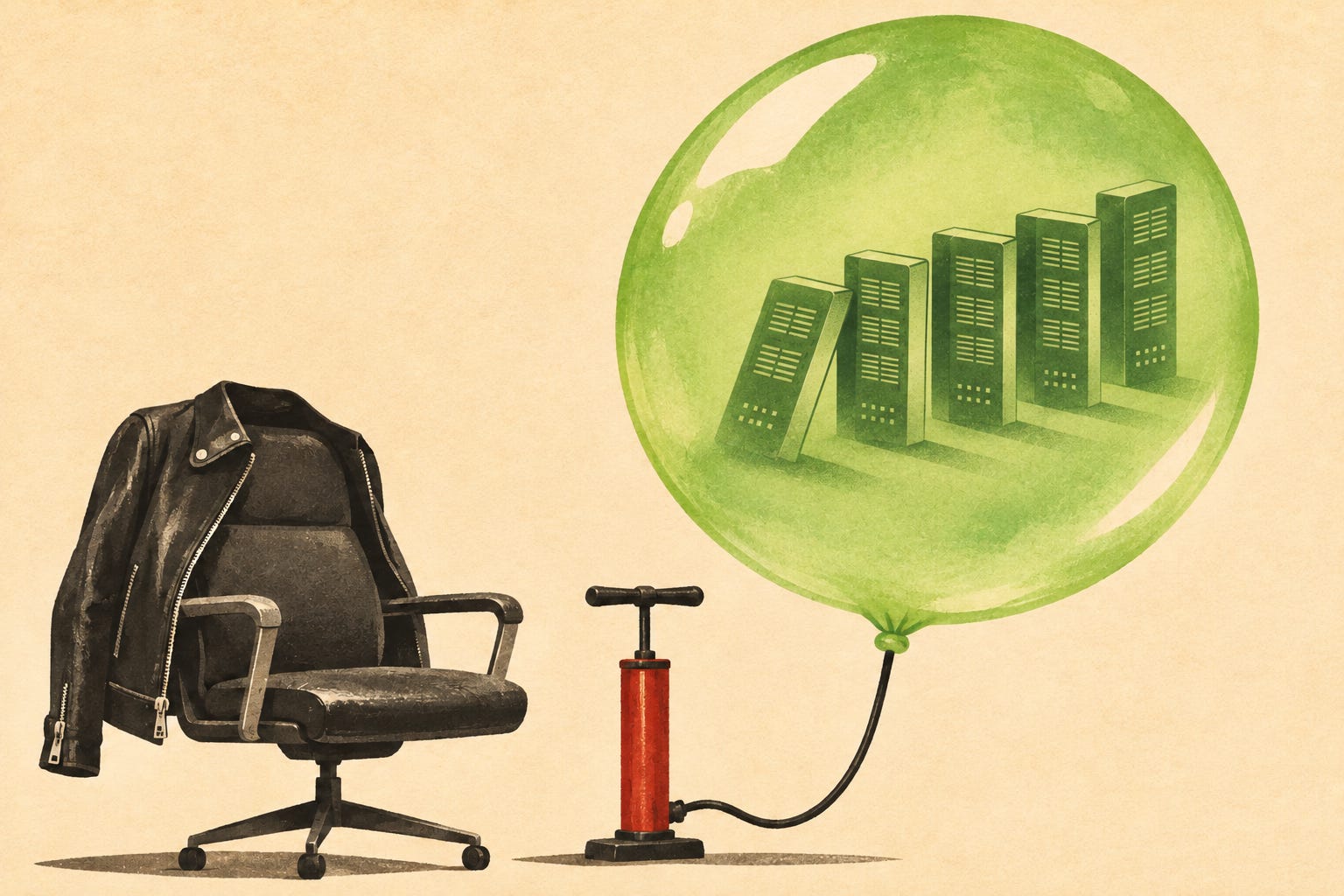
However, my point today is to explain something I have been saying over the last few days, half-jokingly, about Jensen’s departure being what pops the AI bubble. There is some financial logic behind it, which I will explain here.
I still think the demand for AI is real, and that even a bubble bursting would leave us with a lot of good things.
The three ways to finance a venture
To finance a buildout like AI, or previously fibre, or even before that railroads, you can basically use three sources of money: cash from your business, debt, or equity. You use money you already have, borrow it, or convince investors to give you cash in exchange for a piece of the company.
If you think about it, using your own cash lets you keep the upside without owing anyone interest. With debt, you have to repay the loan and interest, but beyond that the upside is still yours. When you sell equity, you share the upside with your investors.
So using your own cash is attractive if you have enough of it. As a startup, most of the other sources are out of your reach, which is why you raise equity.
Now, whoever puts up the money expects a return. At some point the project needs to generate enough cash to cover its costs and give its investors a return, and then invest what is left. That is the financing cycle, oversimplified but enough to understand what’s going on.
What matters here is why this cycle can break. The project might never deliver, or we might run out of financing before it gets there. People can stop trusting the project while the technology keeps improving. We can have real customers and still run out of money.
The dot-com crash in 2000 brought a collapse in venture funding. In 1873, railroad companies struggled to raise enough money to keep operating and refinance their debts, and many failed. Losing trust and running out of money tend to feed each other.1
The financing of the AI buildout
AI requires a ton of capital. Data centres are one piece of it (an expensive one), but electricity, land, chips, wafers… all that is REALLY costly. Estimates put global investment this year at around $1 trillion, with cumulative AI capital spending approaching $3 trillion by the end of the year. To put that into context, $1 trillion is almost half Spain’s annual GDP, and $3 trillion is larger than the annual GDP of about 96% of countries, taken individually.2
Google, Microsoft, Amazon and Meta have been incredible machines for printing cash. In 2021, before the generative AI boom, they produced about $150 billion in combined free cash flow.3 That allowed them to jump into the race, building data centres and spending heavily on chip design and other AI stuff, including investing in AI labs, as Microsoft did with OpenAI and Amazon with Anthropic.
The labs, on the other side, needed investors to finance what they could not yet pay for themselves. Those are the mega rounds that we have seen in the last few years.
But the speed of the buildout has grown beyond what even those cash machines can cover from their current operations. Last quarter, the four big companies together spent about $202 billion on property and equipment, while their businesses generated about $175 billion in operating cash. They still have cash reserves, but more of the next round of spending needs money from somewhere else.4
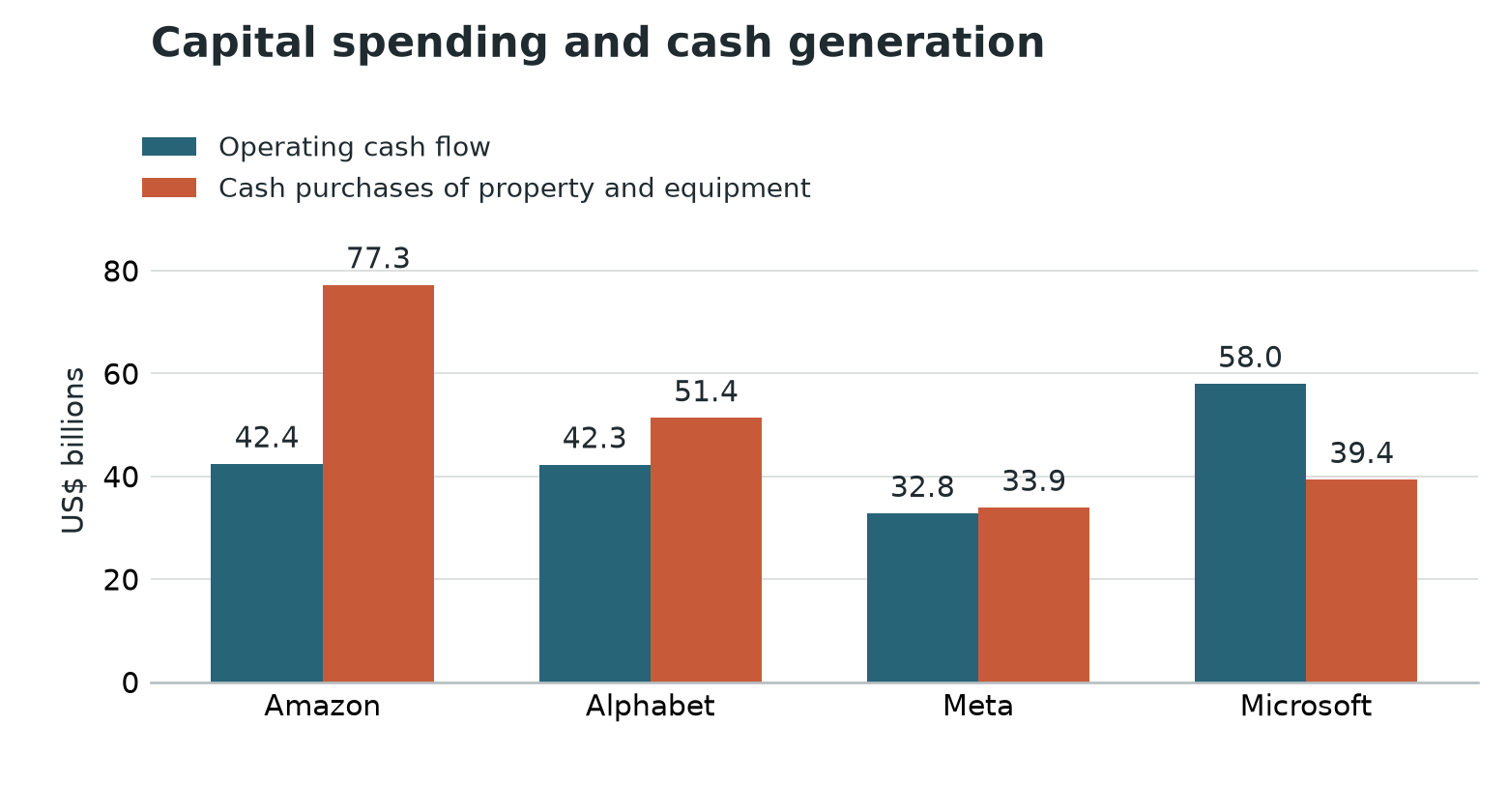
They have turned to the debt markets to keep building at this speed. Borrowing lets them spend money today and repay it from future cash flow, but it also adds interest and repayments to the years ahead. As the bills keep growing, even these companies are asking investors to share more of the bet by selling equity.
Alphabet raised roughly $62 billion through share issuance in the first nine months of the year. Meta announced a plan to raise roughly $100 billion by selling new shares. Amazon has arranged access to up to $80 billion of additional borrowing from 2027.5
In the meantime, AI labs and neoclouds, the specialist cloud companies renting out AI computing, have been tapping into all the sources they can. Including what people call circular financing with Nvidia. I’ll come back to that, because it matters here.6
AI returns
These years of insane investment have also produced some insane revenue curves. Anthropic went from about $400 million in quarterly revenue at the start of 2025 to $17 billion last quarter. OpenAI reportedly reached about $10 billion in quarterly revenue over the same period.7
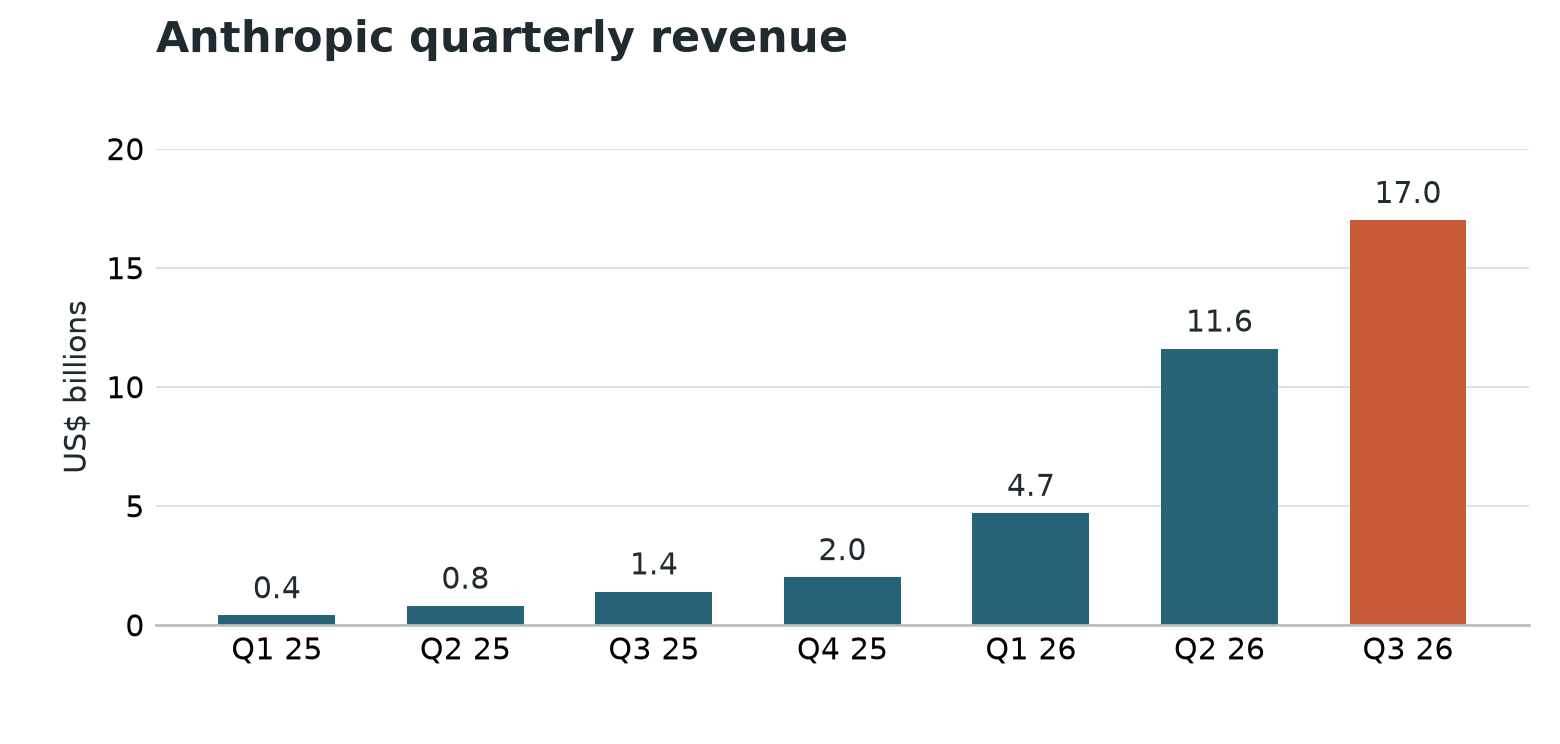
That is real demand, real product-market fit, and it helps keep the enthusiasm going so investors continue financing the buildout.
But even revenue growing like that takes time to turn into enough cash to pay for what we are building. In the meantime, we keep spending on the next generation of models, chips and data centres.
GPUs were the first big winners
Before an AI lab can sell anything, it needs computing power to train and run its models. Much of that comes from Nvidia’s GPUs, so Nvidia makes money while its customers are still working out how to make theirs. Its annual revenue grew from roughly $27 billion in fiscal 2022 to $216 billion in fiscal 2026.8
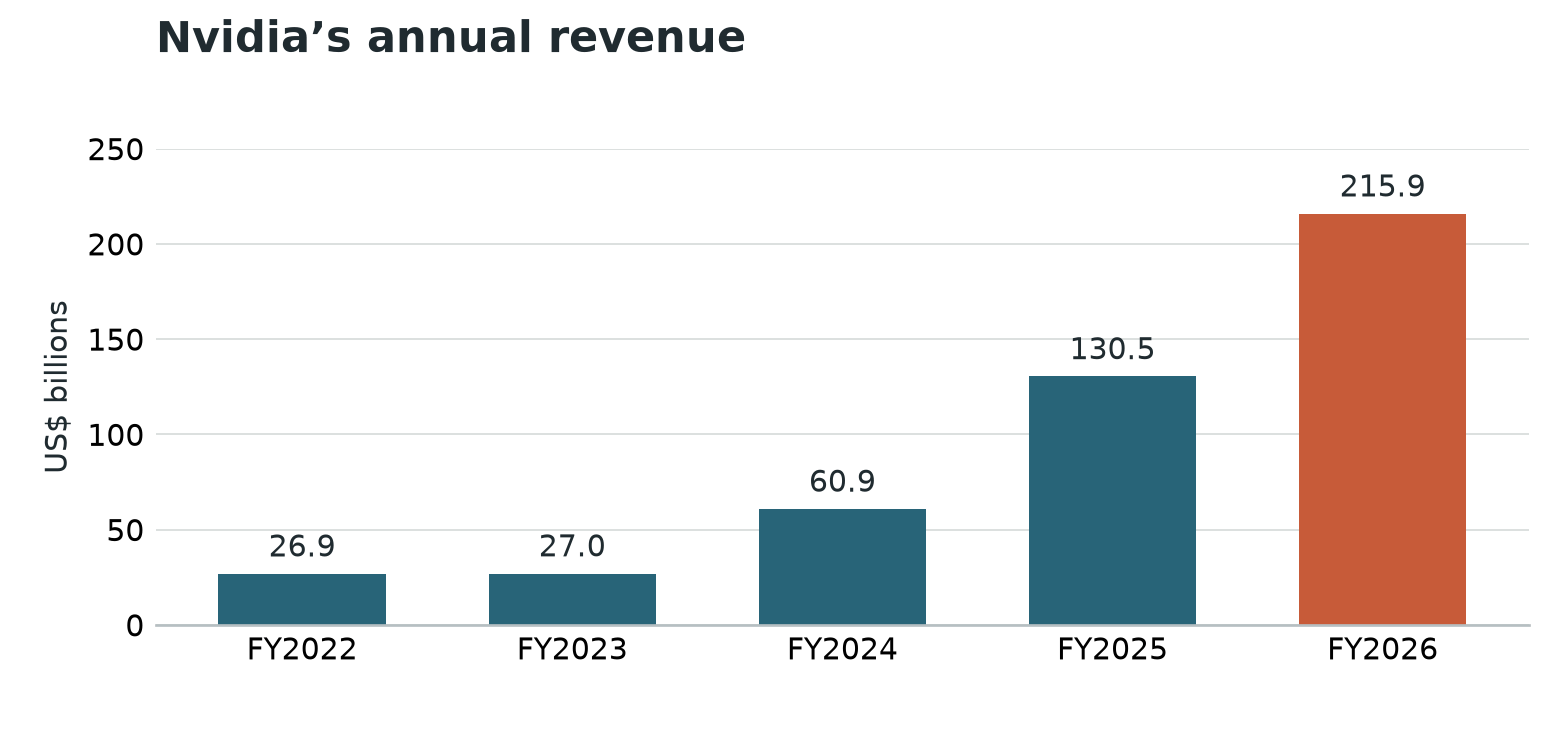
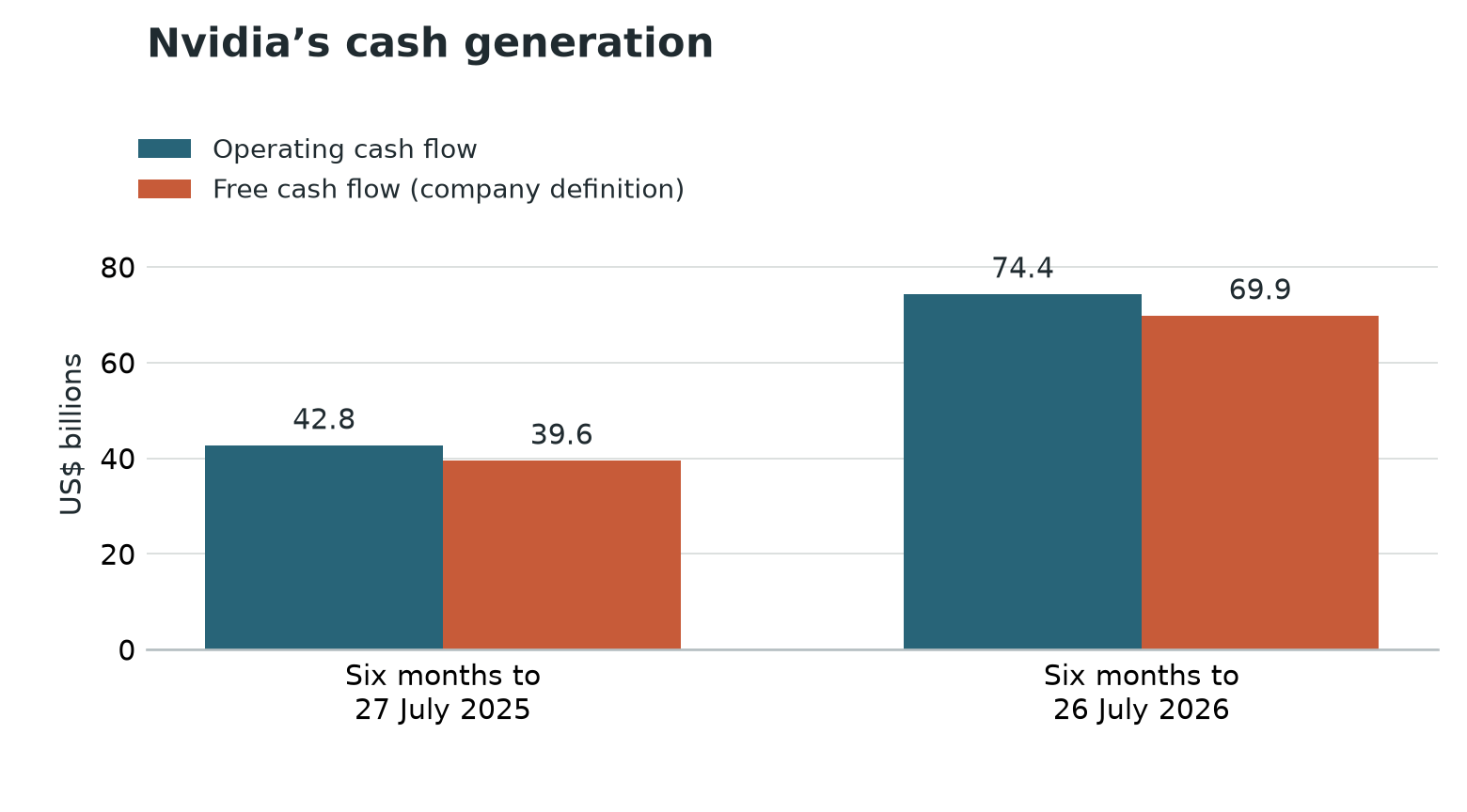
It has been printing cash too, with almost $70 billion in free cash flow in the six months to July, about 77% more than a year earlier.9
Nvidia as the long-term financing partner
I believe Jensen understood this dynamic very well. If his customers can keep building long enough to make money, then they can keep buying chips in the coming years. If the bubble bursts, demand for Nvidia’s chips could fall.
Nvidia needs that cash and demand to keep investing in R&D and stay ahead. If customers run out of financing before they get there, that cycle breaks for Nvidia too.
That is how I understand Nvidia’s investment policy. It has been an investor, a partner and a guarantor for companies building AI. It put $2 billion into Nebius, one of the neoclouds, and committed $30 billion to OpenAI’s funding round. With CoreWeave, it agreed to buy computing capacity that CoreWeave could not sell to other customers, under a deal worth up to $6.3 billion.10
Think about that last one from the perspective of a bank. You are lending to a company building expensive infrastructure, and Nvidia is there to buy some of the capacity if other customers don’t. That makes lending easier. Nvidia’s support can bring in much more money than the amount Nvidia itself puts in.
So yes, some of the money goes in a circle. Nvidia helps finance a customer, and the customer buys Nvidia chips. But there is a long-term business reason for doing it. Nvidia already has the product generating cash, and it can use some of that cash to help its customers reach the same point.
The risk of Jensen leaving
Jensen built Nvidia, thought long term, and had a very deep understanding of the industry. He also had the authority to make these bets. Whoever takes his place may be much less willing to keep financing the industry at this scale. I expect them to be far more cautious with new deals.
Nvidia says its existing commitments will continue, but my concern is what happens to the next deal, or when a partner needs more money. Colette Kress, now interim CEO, had already pushed back on some of Jensen’s financing deals. WSJ reports that she cut Nvidia’s initial commitment to a major OpenAI project roughly in half.1112
Nvidia pulling back from a few companies would not kill AI. The industry is much bigger than that. But it could be the tipping point for the bubble to burst.
If Nvidia becomes less willing to back a project, other investors may start asking why they should keep backing it. A project gets delayed, or a company struggles to raise its next round, and people start looking differently at the other companies making similar promises. Lenders become more cautious, valuations fall, and raising money gets harder for everyone else. The first few problems can create the conditions for the next ones.
That is the risk I see with Jensen leaving. His successor could make decisions that are perfectly reasonable for Nvidia, and those decisions could still trigger a much wider loss of confidence. We don’t need the entire industry to run out of money at once for the bubble to pop.
AI would keep moving, and a lot of useful things would survive. I just hope we get more time to build before everyone starts asking for their money back.
St. Louis Fed on the collapse in venture funding after the dot-com crash; Federal Reserve History on railroad financing and the panic of 1873.
Goldman Sachs estimates about $1 trillion of global AI investment in 2026. SemiAnalysis puts cumulative AI capital spending near $3 trillion by year-end. These estimates have different scopes. The GDP comparison uses IMF data: Spain at about $2.09 trillion, and 184 of 191 economies below $3 trillion. The latter compares several years of investment with one year of output.
Calendar 2021 total: about $152 billion, the highest annual total in 2020–22, calculated as operating cash flow less cash purchases of property and equipment. Sources: Alphabet, Meta, Amazon, and Microsoft, adjusted to the calendar year using its December half-year figures. Asset-sale proceeds and finance-lease repayments are excluded.
Alphabet: about $43 billion of common-stock issuance and $19 billion of convertible preferred stock, including issuance for purposes other than AI. Meta’s plan totals about $95 billion, including a planned $60 billion share-sale programme for 2027; this is not money already received. Amazon’s facility is future borrowing capacity, subject to its terms.
On circular financing: SemiAnalysis explains how Nvidia’s support helps projects borrow; Reuters covers the financing arrangements and concerns; CoreWeave’s filing sets out its agreement with Nvidia.
Anthropic’s November 2026 IPO fact sheet, page 6. Quarterly revenue, not an annualised run rate. Reuters, citing the Wall Street Journal, reported OpenAI’s third-quarter revenue of about $10 billion.
Nvidia’s Q2 FY2027 results. Free cash flow uses Nvidia’s definition. The comparison covers the first six months of FY2027 and FY2026.
Nebius investment, OpenAI funding announcement and CoreWeave agreement. OpenAI’s figure is an announced commitment. Nvidia also disclosed up to $108.5 billion of gross guarantee exposure in its quarterly filing, a maximum potential obligation rather than cash already spent.
Nvidia’s leadership announcement confirms continuity of customer commitments. Axios covers the disagreement. A change in future financing policy remains a possibility, not an announced decision.
The Wall Street Journal reports that Kress questioned Nvidia’s financing deals and cut its initial commitment to a major OpenAI data-center project roughly in half. Anissa Gardizy and Robbie Whelan, “Before His Ouster, Jensen Huang Belittled the Executive Replacing Him.”