
There is a lot of talk about the bubble popping. Let’s take for granted there is a bubble. If AI markets crashed tomorrow, what useful progress would remain, and who could use it? If you have used AI in 2026, I think the response is pretty clear.
I wrote earlier about why I think AI demand is real. Real demand and a useful technology can coexist with inflated valuations and bad investments. I am interested in what all that investment makes possible, including for people who will never own a share in an AI company.
Today I want to make the case for good bubbles as an engine for more growth.
Why I want more growth
In a zero-sum view of the economy, for me to make more money, someone else has to lose it. Technology gives us a way to create more of something useful. If we can produce more food with the same land, there is more to go around. That’s why I love technology. Inventing something useful, and making it succeed, has a necessary precondition: it must make life better for people who had no part in inventing it. That’s why: growth = technology.1
Obviously, growth and technology sometimes come with negative consequences, and sometimes the benefits are also unevenly distributed. Those side effects and inequality bring a lot of people to simply say... we don’t need more growth, we were better off before.
But we can’t accept the simple argument that we don’t need more growth because we are comfortable with what we have. You may be comfortable, but the reality is that there are diseases we still cannot treat, and people who cannot afford the things we already know how to provide. There are droughts and people without water, and there are kids without access to education. Growth and technology can solve those problems, and I find it hard to look at them and conclude that we have enough.
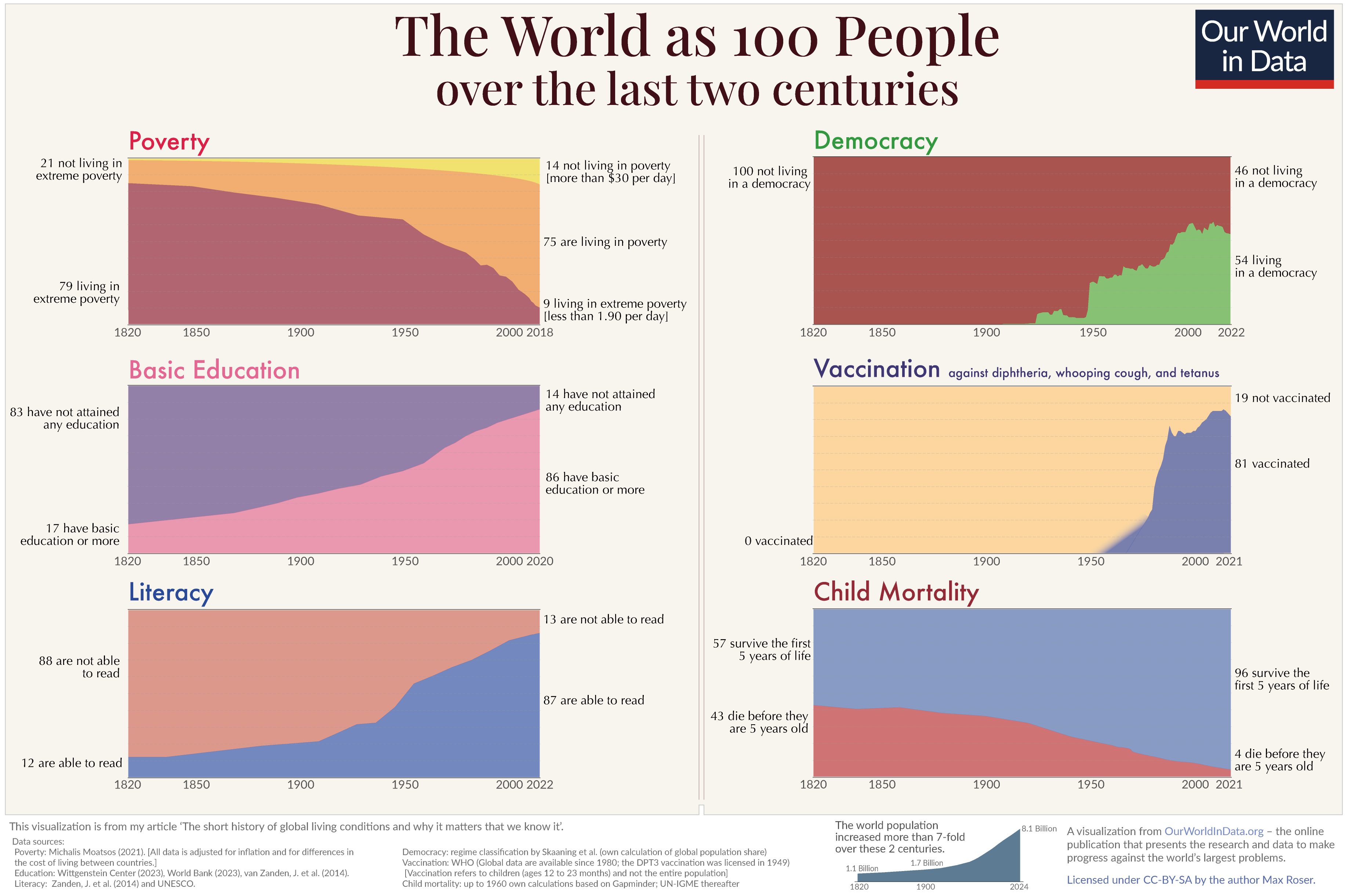
Now, growth can come in increments of 2% a year (or, as we old Amazonians used to say, 200 “bips”) or in bursts. Incremental growth is what we are trained, geared and incentivized for (no one plans to grow 1,000% in a year). It’s true that 2% compounds. Those bursts sound more complicated, but my point is that we need them to maintain healthy overall growth. Within a particular technology, the next improvement can become harder and more expensive, until getting much further means trying a different approach.
A new technology can open another S-curve, with a whole new set of things to improve. The leap can give us possibilities we didn’t have before, followed by years of incremental work to make them useful and affordable. We need people willing to try those new approaches, even when the next quarterly target gives them every reason to stick to what they know.
Big leaps and irrational optimists
Those people also need someone willing to fund them before everything works, and when that is done with what seems like an overly optimistic view of the world, it can be seen as a bubble.
I just finished Boom: Bubbles and the End of Stagnation, by Byrne Hobart and Tobias Huber. Their argument is that a shared vision of the future can get those commitments to happen together. Enough people believe that something will be possible, and capital and talent go into making it possible.
At those moments, expectations can be meaningfully ahead of reality. That is the part of irrational optimism I am interested in. People believe enough to do the work before there is a comfortable spreadsheet proving it will pay off or, more importantly, while many outsiders think that’s a bubble.
Bubbles can pop and destroy a ton of financial value, and yet leave society with useful things. Investors can lose money on work that other people then get to build on. We can be wrong about what a company is worth and right about the importance of what it is building.
A good bubble brings forward useful work that would otherwise take much longer to fund and build, if it happened at all. It gets enough people to commit at the same time for the technology to become useful sooner. The bet is that the value of that head start, and what others can build on it, outweighs the money wasted along the way. I think AI is one of those bubbles.
Of course, that doesn’t make every bubble good. I care about what the money builds, and who pays when it goes wrong. The dot-com boom helped fund networks, software and businesses that others could build on. The subprime boom left houses too (not necessarily better ones), but also debts that spread the damage far beyond the people who made the bets. Leaving something useful behind matters. So does how much damage you do getting there.

What the AI bubble is already building
My usual disclaimer, I run an AI company... I’m biased and I find the AI bubble a good one.
But with the framework above, we already have useful things to point to. The first 3 years of the AI craziness were about making us all more productive (hell yeah, we can now do 100 or 1,000 times more than we did 3 years ago). Now we are also seeing AI contribute to science: protein-structure predictions through AlphaFold, new algorithms found with AlphaEvolve, OpenAI’s release of hundreds of mathematical results, and a reported disproof of the Exponential Time Hypothesis. And as I have repeated a few times, even if progress stopped today (unlikely), we would still have years of benefits to reap.
Research knowledge, trained people, software, chips and power infrastructure have different lives and different conditions for reuse. A person can take what they learned to another company. Software and model weights can remain useful if people can access and maintain them. Intelligence demand is infinite; chips can move from training to inference. Power infrastructure can last much longer.
For a CEO allocating resources, the practical question is how much to spend learning to use what all this investment has built. Good or bad bubbles, losses are losses (as far as I know, there are no extra tax credits for losses on good bubbles, although it wouldn’t be a bad idea). You still need to judge whether the tools are useful for your company, what the team is learning, and how much you can afford to spend finding out.
But, and this is the important distinction, you also need to judge the cost of waiting. It may feel safer to sit on the sidelines and wait for this to resolve. That’s, IMO, even riskier than starting to use the tools. Being right about AI valuations would be small consolation if your business lost its place while you waited.
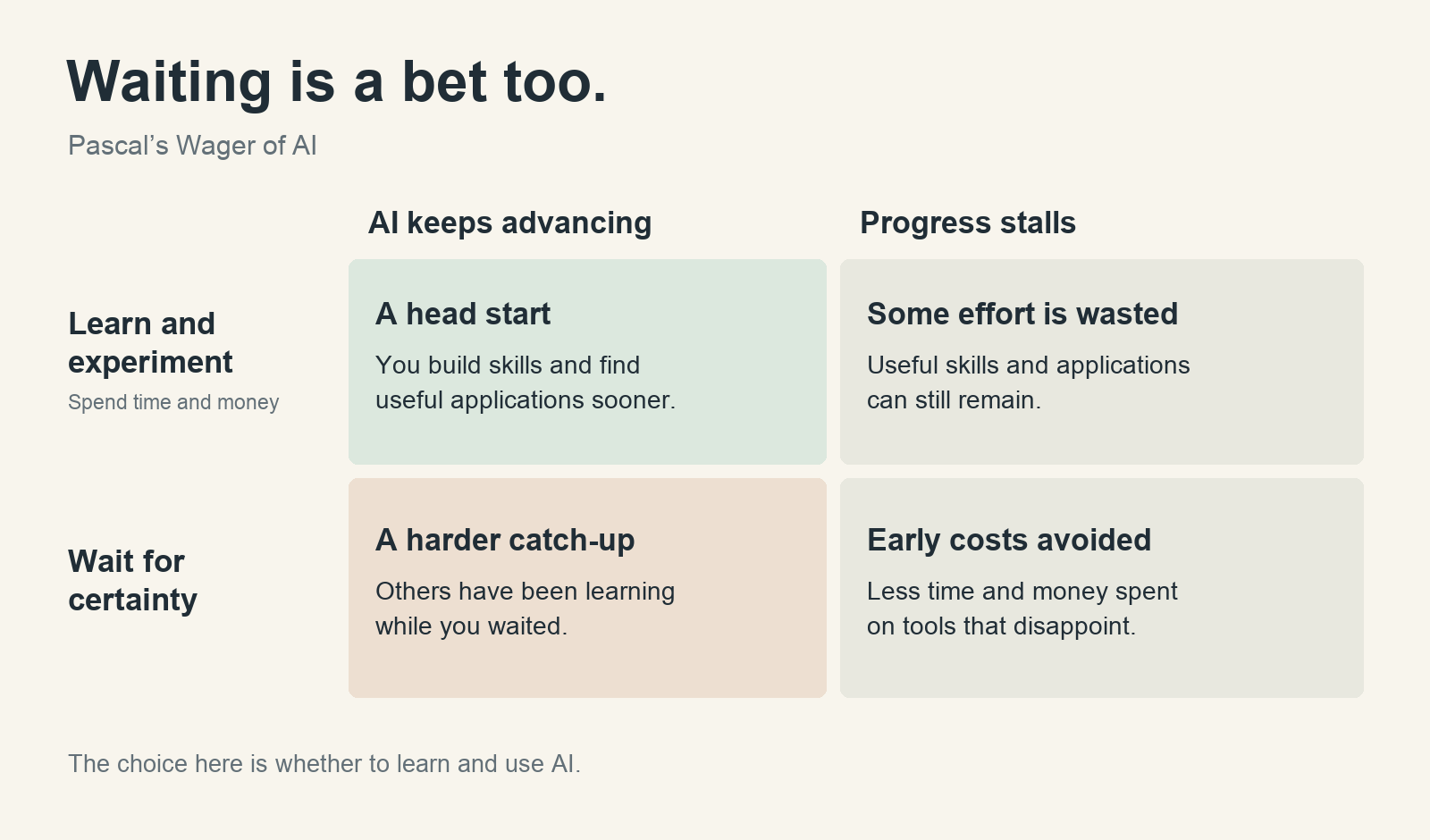
This is what I call Pascal’s Wager of AI. If you invest and learn to use AI and the bubble bursts, you can still have useful skills. If you wait and AI keeps changing your industry, catching up may be much harder, or you may find yourself being the next newspaper.
A good time to be a generalist
The tools that help a company get more work done can also make it cheaper for a person to try something outside their field.
We tend to be hyperspecialized in a field, and that knowledge is important, but AI is also an amplifier for generalist people who are very curious. And again, I’m talking my book. I’ve always said I like being an 80/20, and that kept me out of some places. But now, with AI helping me learn anything I want, when I want, that 80% with a ton of curiosity is an unstoppable weapon. You still need to understand enough to judge what you are doing. But how often could you have Feynman explaining whatever you need?
One example I like is Sid Sijbrandij. I met him this year at a KV summit. GitLab’s co-founder went “founder mode” on his cancer, went deep into his diagnosis and treatment options, and assembled physicians and scientists to explore what could be done beyond standard care. He used ChatGPT to connect his biological data with research and questions for specialists, then put those ideas through expert review before deciding what to do next. Of course, he is extremely smart and talented, and he had a ton of resources. The specialists were essential. But armed with AI, he brought the habits of a software founder into a field he had every reason to learn as fast as possible. The opportunity is to make more of that work possible for people with fewer resources.
That’s an anecdote. My main point is that solving problems that seem unsolvable would lead to disruptive growth. That would require fresh eyes and connecting the dots between many different areas, and AI gives you and everyone else that opportunity.
For me, that’s the key argument for how the AI bubble can fuel exponential growth. AI will help us follow our curiosity further, and we do some of our best work on things we care about. Before, a weekend project might have been mainly for your own satisfaction, with the occasional useful result. Now I think AI will help us all push the frontier. Combine that with investors bullish on AI, and you have the recipe for exponential growth.
A future worth pursuing
I want a future where more cancers are treatable. I also want curious people to be able to attempt a serious idea without first needing to be rich. I want an 80-year-old grandpa starting weekend projects, because why not?
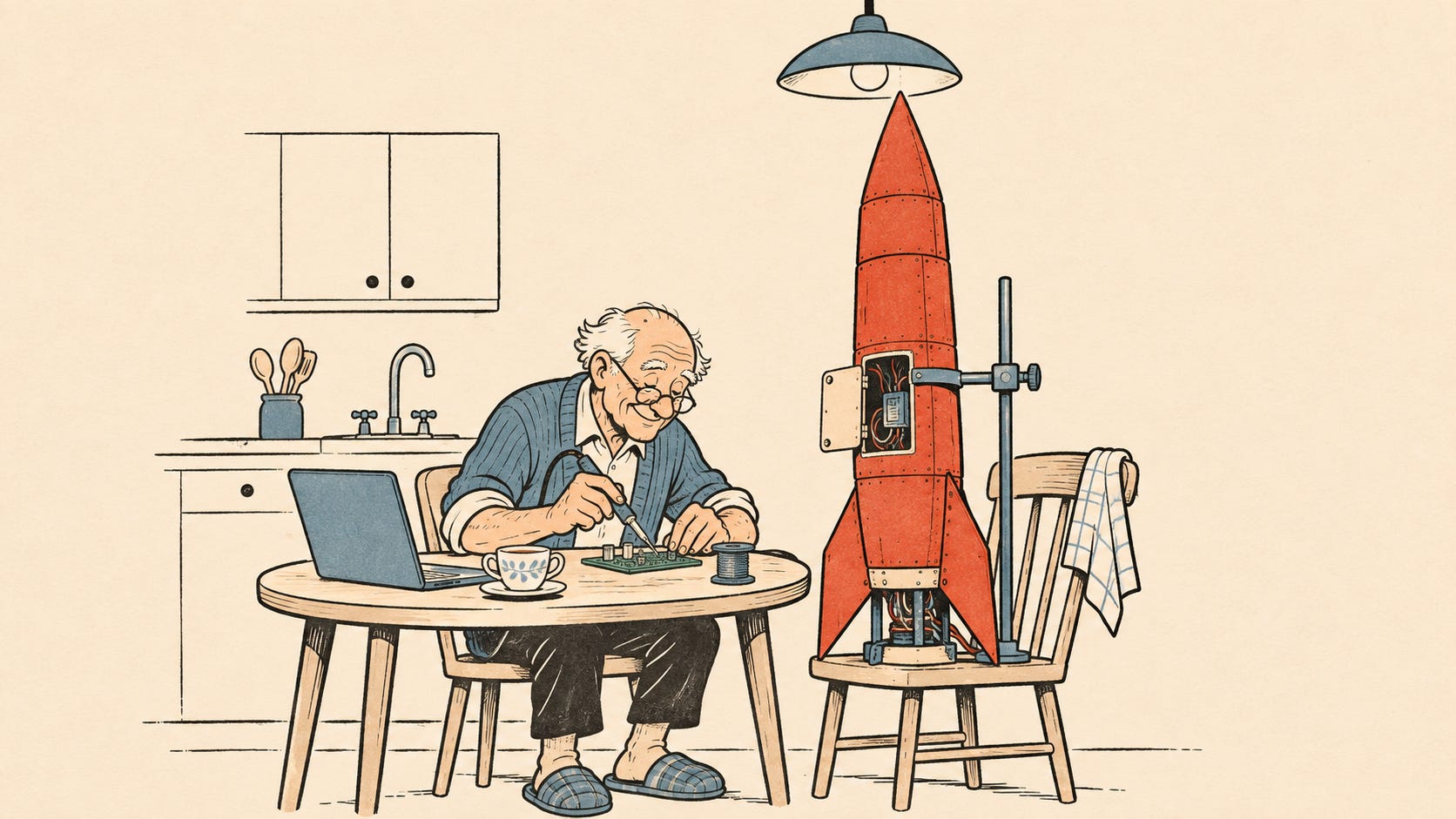
That is what a future of abundance means to me, and I believe it is achievable. A good AI bubble helps fund that growth and leave more people able to solve problems, even if some investments fail. The risks and the job losses deserve attention. So does the work that could make more of us healthier and give us more time and means to do things we care about. We have to build that future and make its benefits available to people. Calling AI a bubble tells us very little about whether we will manage it.
So, is AI a bubble? Maybe... but it’s one that could help us build a better future.
I used to wonder whether I would see changes as big as the ones my grandparents lived through. My grandpa lived through the spread of cars, planes and computers, and saw space become somewhere people could actually go. When I was born, we had been to the Moon already and supersonic passenger planes were flying. But now AI makes me think I might see changes on that scale, and for sure my kids will.
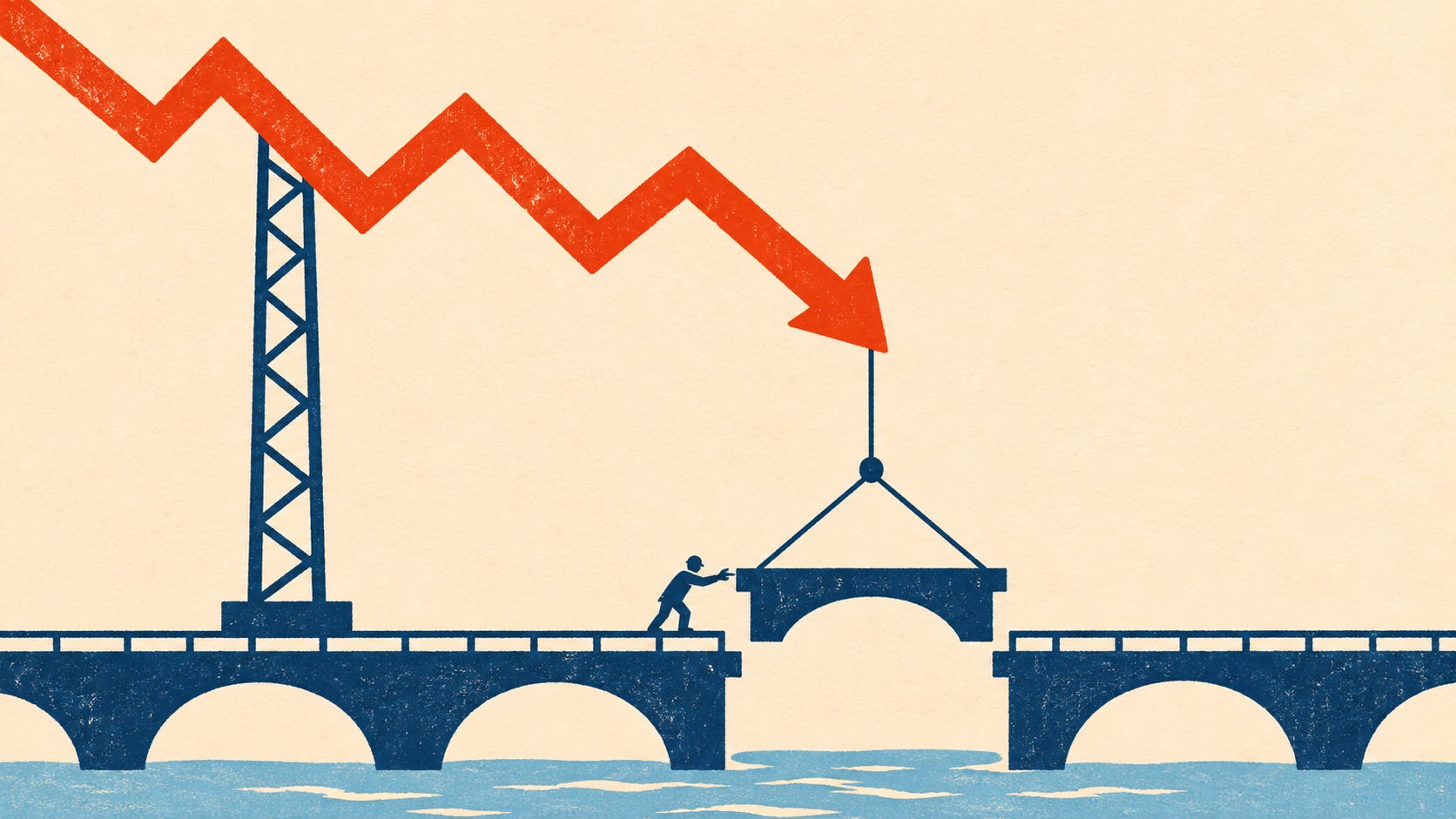
This is shorthand for the lasting gains in what we can produce and do that I care about here. Growth can also come from more labour or capital, trade and better organisation. Technology alone does not guarantee that everyone benefits.