
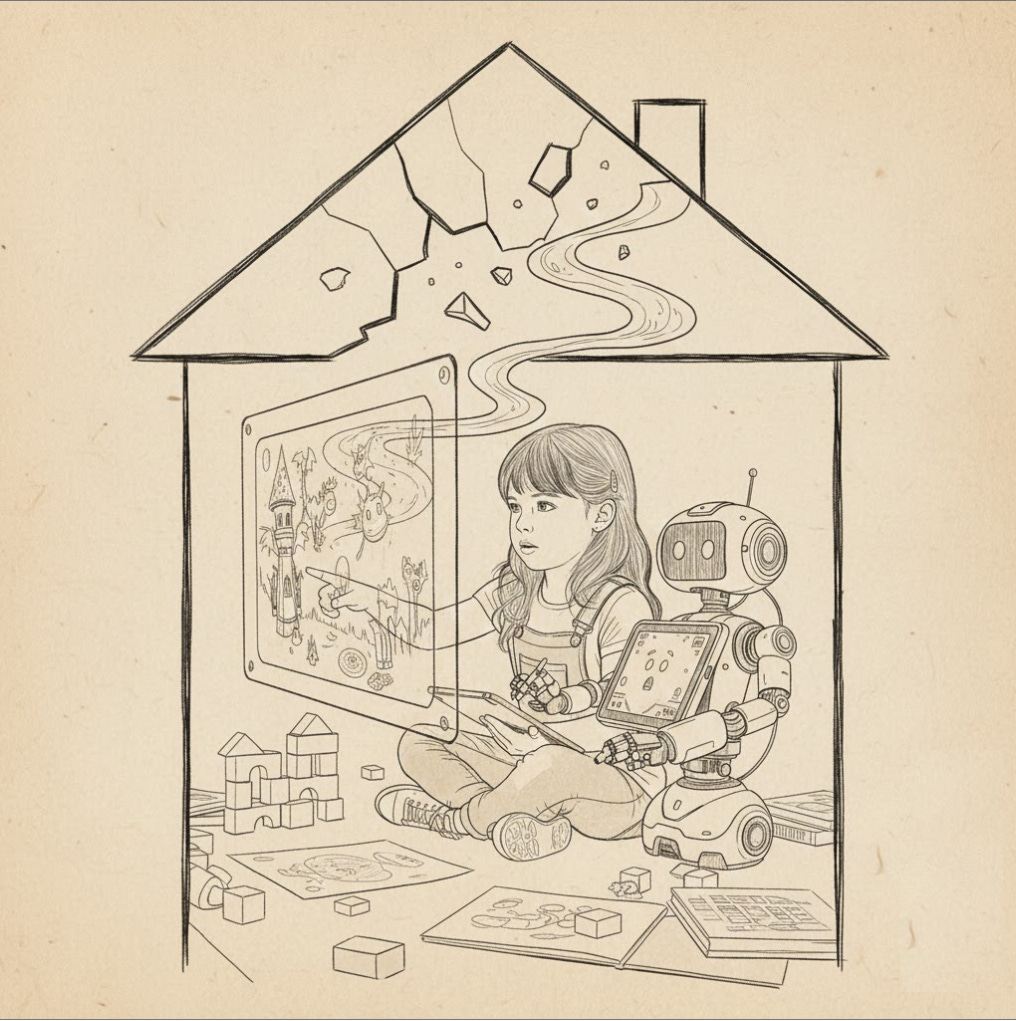
My daughter is six. Last week, she wanted to make a game. Not a board game or pretend, a real game she could play with her brother.
She grabbed the Reachy Mini we put together during Holidays, this little robot you can program by talking to it. Using Claude Code (directed by me) and wisprflow.ai (a dictation app), she told what she wanted: “Make a game where you pick a color and I have to guess it.”
The AI asked her questions. How many guesses should she get? What should happen if she’s wrong? She worked through each piece, tested it on the robot, found it was too easy, made it harder. Thirty minutes later, she had a working game.
I’m not telling you this to brag. I’m telling you because of what happened next.
A few days later, a neighbor friend came over. Saw her playing the game. Asked how she made it. My daughter: “I just told the robot what I wanted.” The friend’s response? “My mom says ChatGPT is for cheating.”
That kid’s ceiling just got set. Not by AI. By her mom.
We obsess over whether AI will harm our children. Wrong question. The harm comes from us. From parents paralyzed by fear, schools banning tools instead of teaching them, politicians gaining votes by talking about AI doom-day scenarios to kids who’d otherwise adapt naturally.
Our relationship with AI determines our child’s relationship with AI. We set the ceiling.
The Harvard Report Effect
One of those silly theories I invent to help me understand the world: pick any topic, there’s always a “research study” that supports your point of view. From time to time, that research study makes it into the media. People who haven’t read a paper in their lives get it out of context. The rest of us see the headlines, and a vague correlation becomes the topic of all the TV experts. And all of a sudden, a new “the expert says you need to XXX” is the new general belief.
AI is no different. Every few months, a study emerges from a prestigious university. Headlines follow: “AI Makes Kids Dumber,” “Screen Time Destroys Attention Spans,” “Technology Ruins Critical Thinking.” The media amplifies it. Parents panic. Schools respond with bans.
Most people can’t distinguish correlation from causation. Eight out of ten, according to a statistic from Harvard (pun intended). So when a study shows kids who use AI score lower on some metric, we assume AI caused it. We ignore alternative explanations: maybe struggling students seek out AI more because they’re already behind, or maybe the test itself measures skills that matter less in an AI world, or maybe we’re testing skills that don’t matter—like memorizing kings.
The pattern repeats every technological shift. I’m old enough (first time that I write that sentence!) to remember a few of these. Television would rot brains. Calculators would destroy math skills. WordPerfect (not a typo, that was a thing) would make you a dumb writer. Google would eliminate memory. Each time, the panic was overblown. Each time, we adapted.
Want to go further back? The Pessimists Archive documents centuries of technology panic. People feared bicycles would cause insanity. The telephone would destroy written communication. Even the printing press had critics who worried it would weaken memory and spread dangerous ideas.
But this time is different, isn’t it?
The Uncertainty Problem
I have two kids. Noa turns sixteen in 2035. Telmo will be thirteen. I spend unhealthy amounts of time thinking about what their world will look like. I can’t predict it. Nobody can.
I’m biased, I’m techno-optimistic. I believe technology makes us better, not worse. But even if you’re skeptical, the forecasting problem remains the same.
Forecasting is hardest when the rate of change accelerates. When I was eight and when I was twenty, the gap was enormous, but at least the direction was predictable: faster, cheaper, smaller technology. For my kids of today, the world might be unrecognizable by the time they graduate.
This uncertainty produces two failure modes. First, we try to predict specifics and optimize for scenarios that won’t materialize. Second, we do nothing because we can’t see clearly enough.
Both are mistakes.
The things that will always matter are slim and summarized in two: agency, and taste But you can’t directly teach these things. You can only model them. And kids are more likely to develop them if the adults around them treat uncertainty as normal, not terrifying.
We can’t teach our kid to be adaptable to a future we’re terrified of. Fear is contagious. So is confidence.
Why We’re Probably Overreacting
The evidence for catastrophic harm isn’t there yet. Some studies show concerns. AI might reduce critical thinking in specific contexts. Children trust AI outputs too readily without verification. Social development could suffer if kids replace human interaction with chatbots.
These are real concerns. They’re also manageable.
Compare them to the documented benefits: personalized tutoring at scale, accessibility for learning disabilities, instant feedback that accelerates learning, democratized access to education globally. AI can already do things we couldn’t afford to do for most children before. At Luzia, we’ve seen millions of users in Latin America get access to quality education tools they never had before.
The question isn’t “Is AI risky?” Of course it’s risky. Everything is risky. Car accidents kill more kids than all illnesses combined, and we still drive them to school every day; we just make them wear seat belts and child restraints.
Avoidance means your kid falls behind while others build fluency in something I’m certain is here to stay. Engagement means you guide them through the risks. Easy choice.
Technology Is Here to Stay
Even if I’m wrong about AI being net positive, it doesn’t matter for most of us. AI isn’t going away. You can’t protect your kids from it by pretending it doesn’t exist. You can only protect them by teaching them to use it well.
If we’re constantly on our phone complaining about technology, guess what our kid learns? That technology is both irresistible and shameful. Not a great combination.
Arguing that AI is bad is the easy path. It requires no learning, no adaptation, no discomfort. Just moral certainty and fear. Learning how to make the best of AI is harder. It requires curiosity, experimentation, tolerance for failure. We almost always take the path of least resistance. But the path of least resistance today creates the most resistance tomorrow.
Think about calculators. Schools initially banned them. The fear was rational: kids would never learn arithmetic. But once calculators became ubiquitous, the ban became absurd. Today, nobody argues we should remove calculators. Instead, we teach when to use them and when to do math by hand.
AI will follow the same arc. The schools banning ChatGPT today will integrate it tomorrow. The parents terrified now will normalize it soon. The lag between panic and acceptance creates opportunity for some kids and disadvantage for others.
The kids whose parents figured it out early get a head start. Ours can be one of them.
When IQ Becomes a Commodity
This time feels different because we’re not automating a narrow task. We’re automating what made us feel different for generations: intelligence itself.
But we’ve been here before.
Long ago, we taught hunting and fighting. Raw power mattered. Then machines made strength a commodity, and we shifted to dexterity: farming, crafting, building. The industrial revolution automated dexterity, so we pivoted to IQ. For the past century, education meant developing intellectual capability: reading, reasoning, problem-solving.
Now IQ is available like water from a tap.
Andrej Karpathy, one of the best programmers alive, recently wrote:

If Karpathy feels behind, what chance does everyone else have?
The same transformation is coming for every knowledge worker. When raw intelligence becomes a commodity, what’s left?
Agency and taste.
Agency is the sense that your actions matter and the habit of starting things anyway. Taste is knowing good from mediocre when infinite options exist.
A kid asks AI to help write a story. Agency is deciding to write it in the first place. Taste is reading what AI generates and saying “this is boring, make it funnier”—then iterating until it’s actually good.
These skills aren’t taught in schools. They’re modeled at home.
Our AI Literacy Sets Their Ceiling
If you don’t understand AI, you can’t teach your kid to use it responsibly. You can’t model good judgment about when to use it and when not to. You can’t help them debug when it fails. You can’t show them how to verify outputs or recognize hallucinations.
Our ignorance becomes their limitation.
This isn’t about learning to code or becoming an AI expert. It’s about basic fluency: knowing what AI can and can’t do, understanding its failure modes, developing intuition for when it’s useful.
Most importantly, it’s about your relationship with the technology. If you treat AI as magical or terrifying, your kid absorbs that. If you treat it as a tool, with all the goods and the bads, they learn to use it pragmatically.
Schools will eventually catch up. Eventually. But they’re slow. Universities are banning AI in assignments while the job market demands AI fluency. High schools are fighting plagiarism battles instead of teaching citation and verification. Elementary schools are doing nothing because nobody knows what to do.
Meanwhile, children whose parents are AI-literate are already building things, learning faster, and developing skills the educational system hasn’t figured out how to test.
The gap will widen before it narrows.
Schools Will Need to Rework Curricula
Remember memorizing kings? Spanish history taught through rote memorization of Gothic kings? Completely useless knowledge, but schools taught it for decades because the system was slow to change.
We’re doing the same thing now. Giving kids tablets and calling it “digital literacy” when they’re already digital natives.
The current educational model optimizes for memorization and standardized testing. AI demolishes both. Why memorize facts when you have instant access to all knowledge? Why practice arithmetic when computers calculate faster?
Yes, struggle builds character. As Cleo Abram discussed with Mark Zuckerberg, doing hard things matters. But there’s productive struggle—learning to think—and pointless struggle—memorizing facts Google knows.
We still teach kids arithmetic even though calculators exist. Why? Because understanding basic math helps you know when the calculator is wrong. The same logic applies to AI. Kids still need writing skills to know when ChatGPT produces garbage. They still need critical thinking to evaluate AI outputs.
The curriculum needs to shift focus:
Critical evaluation: How to verify AI outputs, recognize hallucinations, cross-check sources. Research shows children as young as preschool can learn AI literacy.
Problem framing: AI executes well but needs clear direction. Asking good questions matters more than knowing answers.
Creative judgment: When a thousand options exist, taste determines value.
Human skills: Empathy, collaboration, leadership, communication. The harder these are to automate, the more valuable they become. As one education leader notes, “the biggest lesson we’ve learned is, it’s not about the content.”
Schools will resist this shift. They always do. The institutions most invested in the old system are slowest to change. This creates a window where parents can substitute: teach your kids these skills at home while waiting for schools to catch up.
Or don’t wait, work on it at home.
The Gap
We’ll adapt. We always do. And that unrecognizable world of 2035 will be simple 2035. But how well we adapt depends on how much we make of AI, not whether we avoid it.
The gap between what institutions teach and what matters is ridiculous, and widening.
Schools optimize for plagiarism detection while the job market demands AI fluency and agency. They ban ChatGPT while employers expect AI-augmented work. They test memorization when memory is free.
But it’s not just schools.
I recently spoke at a large tech company about AI. I started my talk with a simple question: “How many of you think this company needs to invest more in AI training courses?” Everyone raised their hands.
Everyone, at a tech company, full of what I am pretty sure was high IQ people.
“You all work here. AI is new for everyone. Get the agency you need to get up to speed. Don’t wait for the company to teach you.” Those who know me will know I used slightly non-post-friendly wording. ;)
The silence was uncomfortable.
This is the problem. Adults lack agency too. We wait for permission, for training programs, for someone to tell us it’s okay to learn. Then we pass that learned helplessness to our kids.
The way I see it, two groups of children are emerging: Group A, kids making things happen. Group B, kids told AI is cheating, banned from experimentation, learning that trying new things requires permission
The gap between these groups will be enormous. Not because Group A has better AI, but because Group A has agency and Group B doesn’t.
What to Do
Stop waiting for perfect information or politicians’ guidelines. You won’t get it. The studies are contradictory, the experts disagree (for God’s sake, there are no experts—this is new!), and the technology changes faster than research can track.
Instead, model what you want them to learn. Use AI yourself. Let them see you experiment, fail, adjust.Show them that “I don’t know how” could be the beginning of something cool. Let them try things under supervision—prohibition builds naivety, experimentation builds judgment. When they create something with AI, don’t just praise it. Ask: “Is this good? How could it be better?” That’s how taste develops. And balance AI with what AI can’t replace: human connection, physical activity, unstructured play.
Push schools to adapt. Not through angry emails, but through questions: How are you teaching kids to use AI? How are you using AI? What’s your plan for when every student has access? Are you preparing them for the world as it will be, or as it was?
Most importantly, relax. Our kids will be fine. They’re more adaptable than we think and there will be a new Harvard Study to prove it soon.
AI systems want to learn. They’re designed to improve through interaction, to get better with feedback, to adapt to new patterns. Humans are the same. The models learn through trial and error. So do your kids. The difference is: the models don’t need permission to try, our kids do. And we’re the one who grants it.
We adapted before. We’ll adapt again.
You set the ceiling.
In ~370 BCE, Plato objected to writing. He believed it would cause an end to wisdom.
In 1954, Fredric Wertham argued that comic books were “an invitation to illiteracy,” that stimulated “unwholesome fantasies” & fostered cruelty and deceit.
The ceiling that has always been used is "morality," despite the irony that perhaps the largest moral crisis each era of tech has faced is the improper restriction of it.