
My head of product built a full WhatsApp and web app, end to end, in a week. Not a prototype. A real Luzia product used by thousands of people, with networking, security, and production constraints.
This is not a story about Javi being exceptional. He is, but that’s not the point. The point is what became possible, and how fast it changed. Twelve months ago, this would have been a three-month project and a small engineering team. What changed?
Writing software got radically cheaper and faster.

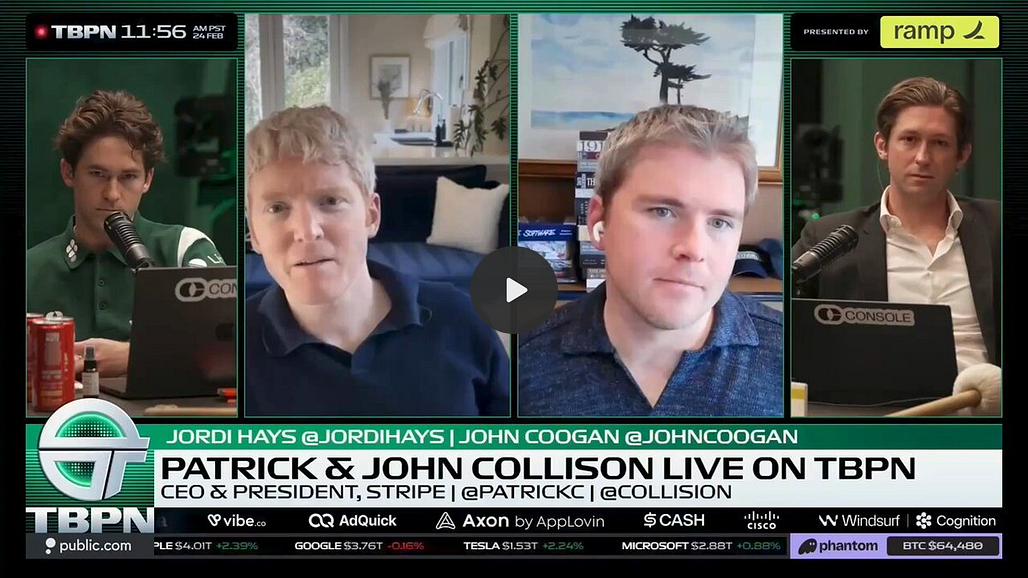
In the span of a few months, most frontier companies, Luzia included, moved to AI-written code as the default. At this point, AI writes the overwhelming majority of the code we ship. Internal benchmarks suggest productivity has nearly doubled. It happened fast, and it did not happen gradually. It flipped. One model update in November changed the game.
I don’t know whether the same thing will happen in your field. It might happen in months, in years, or never. But I do understand the mechanism: things stay hard until they don’t, and when the flip comes, it is not gradual.
Last week I was trying Claude’s Cowork, the thing that sits on your computer and handles tasks for you. My first reaction was: not there yet. Then I remembered what coding agents felt like a year ago. Same reaction: nice idea, doesn’t really work. Then November happened, and coding flipped. I’m not frustrated about Cowork anymore. I’m forcing myself to use it.
That is why I’m writing this.
The gap is still closeable
The gap between where you are and where the best AI users are is still closeable. That will not be true forever.
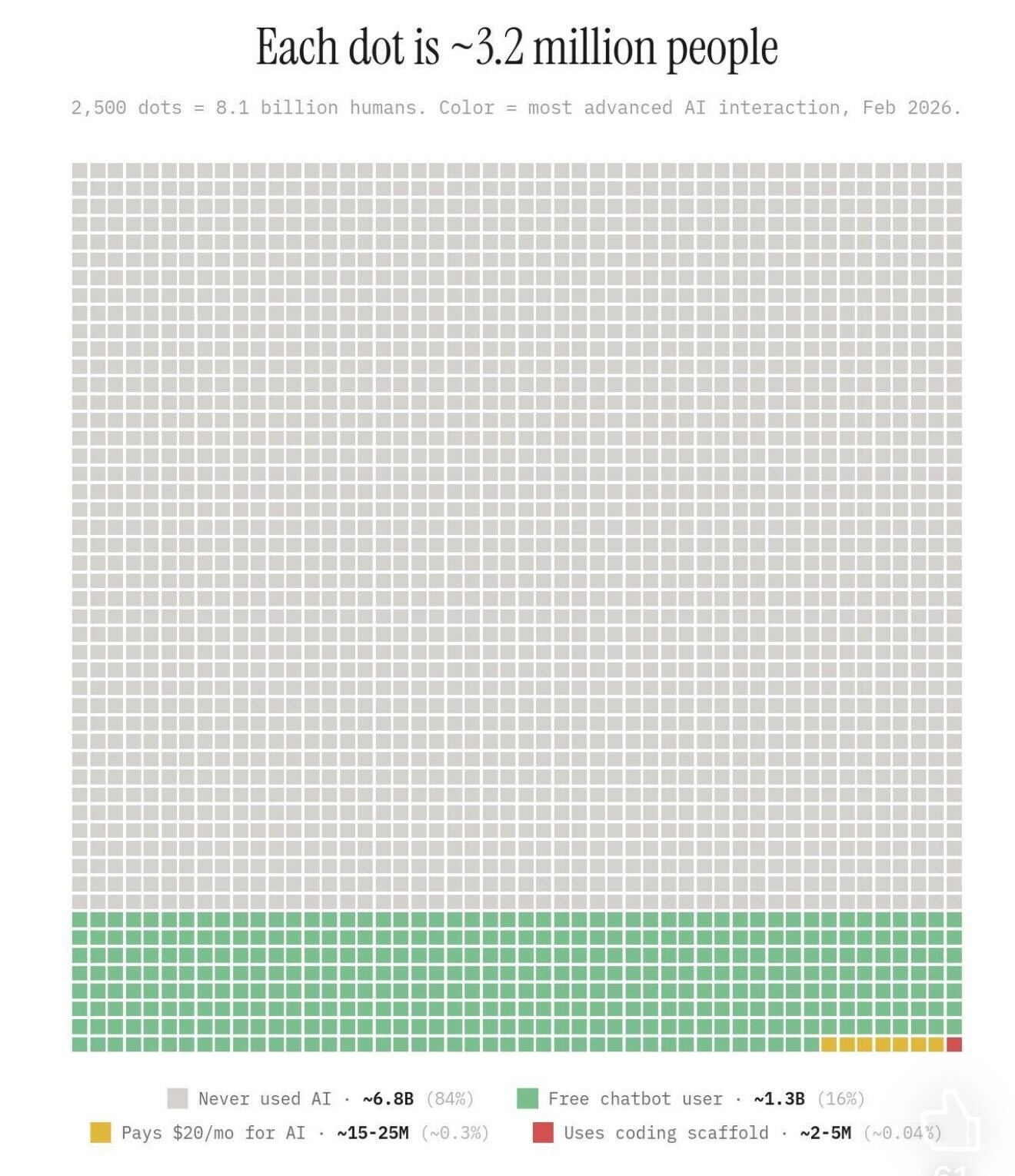
Right now, the frontier is visible. You can still reach it. The tooling is accessible, the models are good, and most people still have not seriously tried. Most usage is still first-layer stuff: summarize this email, fix my grammar, rewrite this paragraph. Most people have not touched the second or third layer. I wrote recently about the gap of imagination: the distance between what AI can do and what people actually ask it to do. That gap exists at the industry level, where we keep rebuilding chatbots, but it also exists at the individual level. This post is about that second gap.
Keeping up is hard
Keeping up with AI is genuinely uncomfortable, for reasons that are worth naming.
The external ones are obvious. The rate of change is absurd, which makes it hard to keep up. There is an enormous amount of noise in the AI space, which compounds the problem. Separating signal from hype is almost a full-time job. And on top of all that: nobody actually knows what will be possible in six months. Maybe the labs know. We don’t.
The internal ones are less obvious. Keeping up requires doing things most of us naturally avoid: sustained effort, constant updating of priors, the discomfort of being bad at something before you become good at it. What didn’t work a month ago might work now, which means you have to be willing to try things you already tried and failed. That’s psychologically harder than it sounds.
And there’s a third thing. The fact that software is cheap now means that eventually more people will be able to do these things too. When a skill becomes widespread, the bar for good and good-enough rises. Competition doesn’t reward good, it rewards being ahead. That’s not an argument against pushing. It’s the argument for pushing now, before the new standard hardens.
And underneath all of it: what if I work this hard, and nothing flips in my domain? That’s the fear. I get it.
That’s what the 2x2 helps us understand1.
But what if I’m wrong?
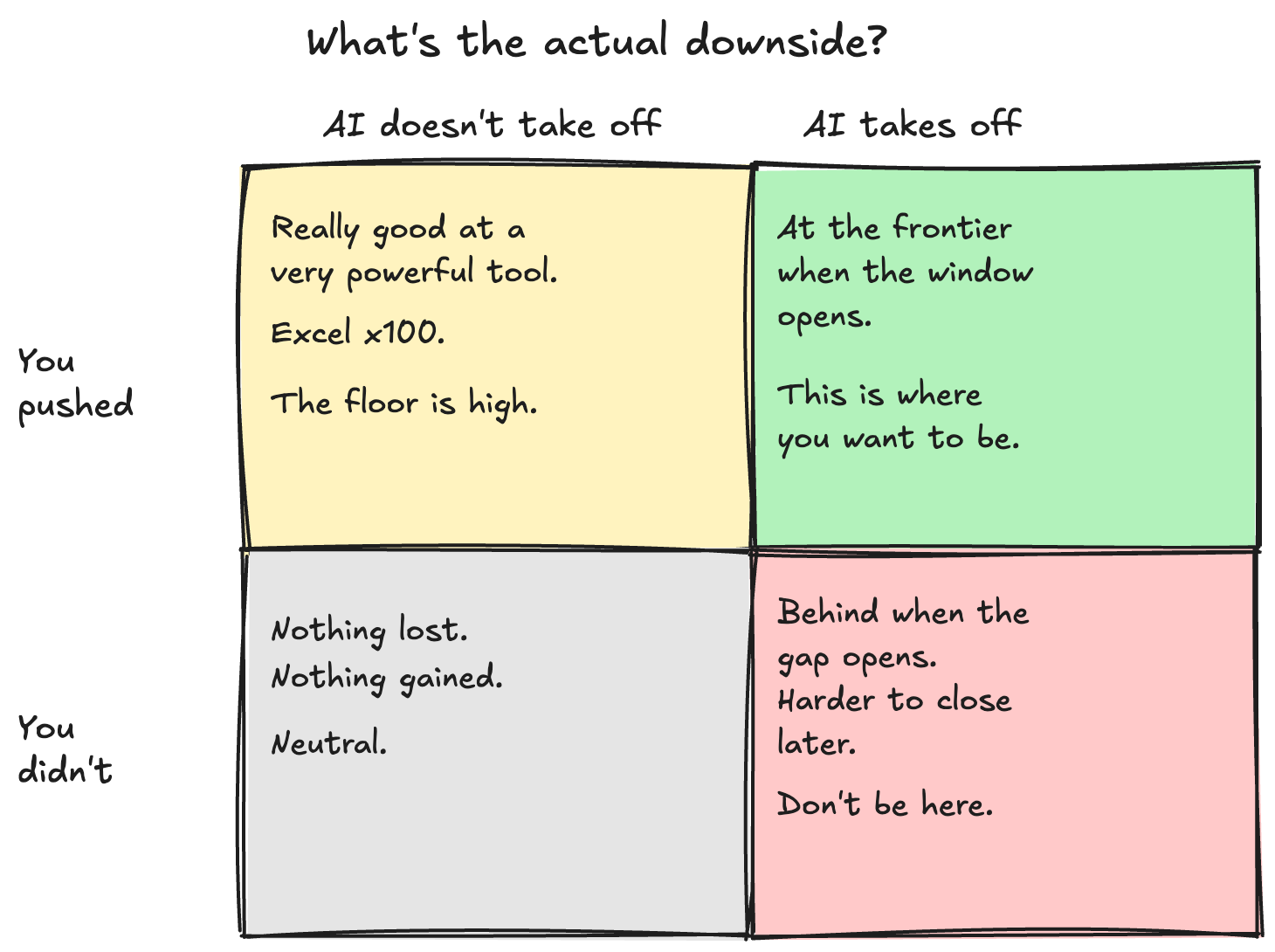
Start with the obvious inner objection: what if this never really takes off? What if the bubble bursts, and AI turns out to be a huge wave of talk that goes nowhere? What if I work hard for the next 12 months and this scenario never materializes?
Paul Graham has a famous essay about doing what you love. One of its core ideas is that people who work on things they genuinely love have a structural advantage: what feels like painful effort to others feels almost like a hobby to them. I agree with that completely, and it has mattered a lot in my own life. But I also think the ability to enjoy learning new things is itself trainable. And right now, there are not many alternatives. We have to learn.
The worst case of working hard on AI is that you become very good at a very useful thing. For years I taught Excel and financial modeling, and I watched people waste entire days on problems that one formula would have solved. AI feels like that, multiplied by a hundred. (if only people in the world understood sumifs). Even if progress stopped today, knowing how to use these tools is worth a lot. The floor is high.
The upside case is different. When AI coding suddenly became far more usable, the people already close to the frontier benefited immediately. The people who waited to see whether it was real were left with a gap that is now harder to close, not easier.
I believe that if this moment comes, the outcome will be brutal and barbelled2: some people will do unbelievable things, and others will fall badly behind. The choice, right now, is whether you want to be close to that frontier when it happens.
The noise around AI risk
There is one more thing here that frustrates me.
Much of the public conversation about AI is focused on risk. Researchers, journalists, regulators. Some of those risks are serious, and someone does need to think about them. But for most people, the effect is not careful engagement. It is paralysis. People close off instead of leaning in.
My instinct is that the best protection against the downsides of AI is broad adoption, not avoidance. The disruption that might come will be smaller, and more manageable, if as many people as possible are using the technology and benefiting from it. The worst outcome isn’t that AI is powerful. It’s that AI is powerful and only a small group knows how to use it.
Your job is to make sure you are not left behind while others are still debating what this means.
How to start
Get mentally ready first. This is going to be uncomfortable. The rate of change is fast, the signal-to-noise ratio in the AI space is terrible, and you’ll have to constantly update things you thought you knew. That discomfort is the point. If it were easy, it wouldn’t be an opportunity.
Default to AI more often than feels natural. Make “AI first” a real heuristic. Make it a rule: AI first. Most things won’t work. Some will surprise you. What matters is that you build an intuition for where the edges are, and those edges are moving. What failed last month may be trivial today.
Pay for a real subscription and actually push it. Not the free tier. Then use it for problems that feel slightly above your level. The people who get the most out of these tools are the ones who give them hard problems, not the ones who use them only for email.
Do not be afraid to ask stupid questions. For the first time, we have a technology that is endlessly willing to help you learn. You just have to ask.
Build something. Anything. I don’t care how small. You have a problem, you have a tool, and you can probably connect them in an afternoon.
With the main barriers gone, what remains is agency and taste.
There are very few moments in a career where the asymmetry is this good, where the floor is high, the ceiling is very high, and the window is visible but closing.
The cost of this opportunity is hard work. That is not such a terrible price.
P.S. I do not usually write in this tone, but this one matters. More and more people are reaching out because they feel they are falling behind. The anxiety is real. The peer pressure is real. That is exactly why now is the time. I’ll get back to more technical topics soon.
This 2x2 is a reinterpretation of Pascal’s wager: when the cost of being wrong is asymmetric, the rational move is to be on the side with the higher upside.
A barbell effect describes a scenario in which outcomes concentrate at the extremes, with little in the middle. In this context, the people who pushed early will be able to do unimaginable things today, and be rewarded accordingly. People who didn’t will find that the baseline moved without them.