
Most people use AI the same way they could have in November 2022, when GPT launched and the model at that time couldn’t do basic math. The same model family is now solving 100-year-old math mysteries.
Fidji Simo calls this “capabilities overhang.” Benedict Evans calls it lack of product-market fit. I’m not arguing with either of them, they’re both right. But I want to go one level deeper, because I have a strong hypothesis of why it happens, and I think that’s the more useful question for anyone building on AI. And it comes down to two things we, as product builders, are getting wrong.
First: we keep trying to solve everything with a chat interface. I wrote about that in my 2026 predictions - the year of boring AI I called it, where the real wins come from workflows, not chatbots.
Second, and more important: we are not closing the gap of imagination.
That’s what this post is about.
Here’s a diagram I drew in 2023 when I started Luzia. The idea was simple: make sure people don’t fall too far behind the frontier. But “not falling behind” has two requirements. People need to use AI. And people need to actually extract value from it.
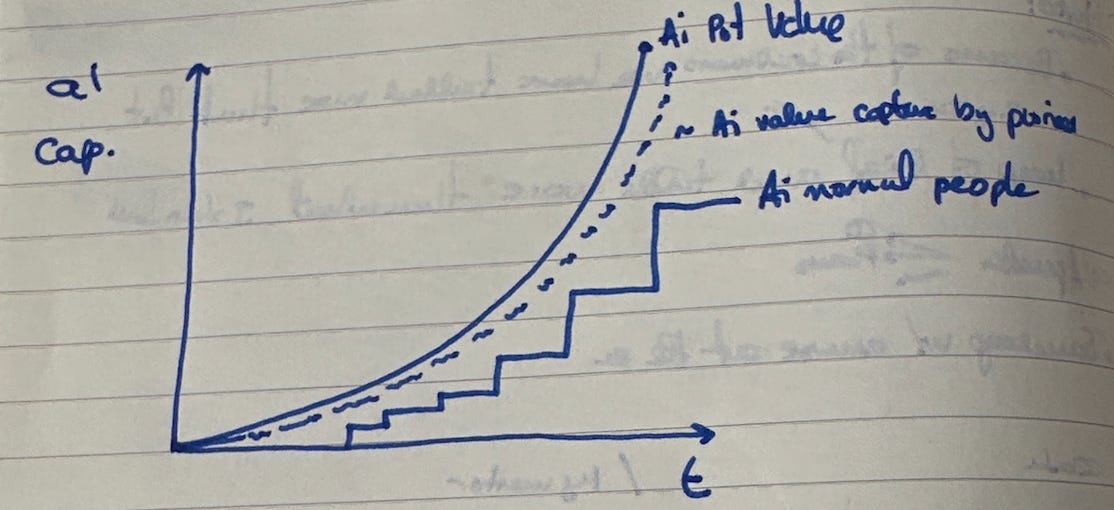
We at Luzia, and the industry, got decent at the first one. The adoption curve AI achieved is unlike anything before it. But we have mostly failed at the second.
Why people are not finding the value?
To understand why, you need to understand what AI actually is today. The most bullish answer is “almost everything.” The more honest answer looks like this:
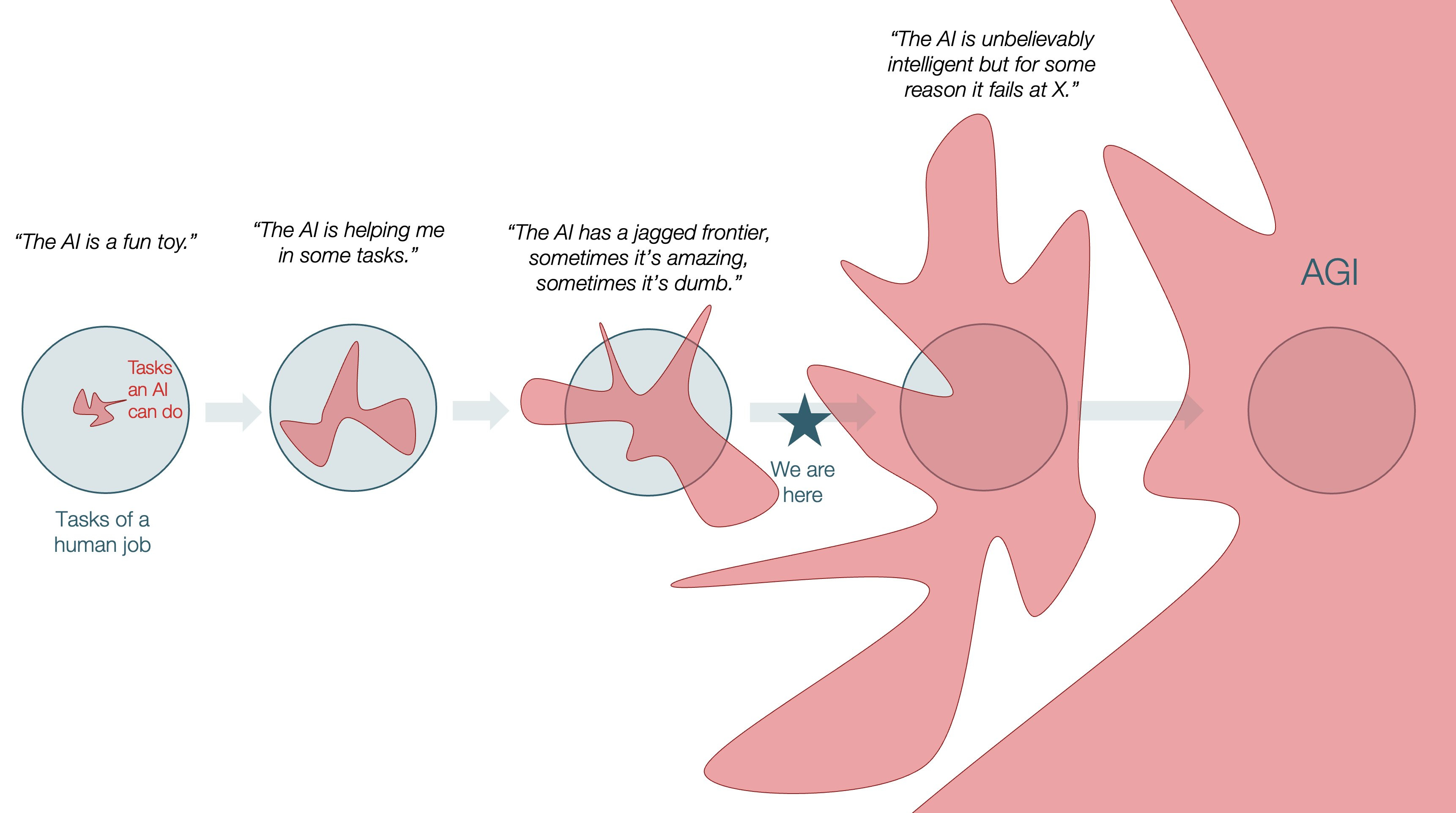
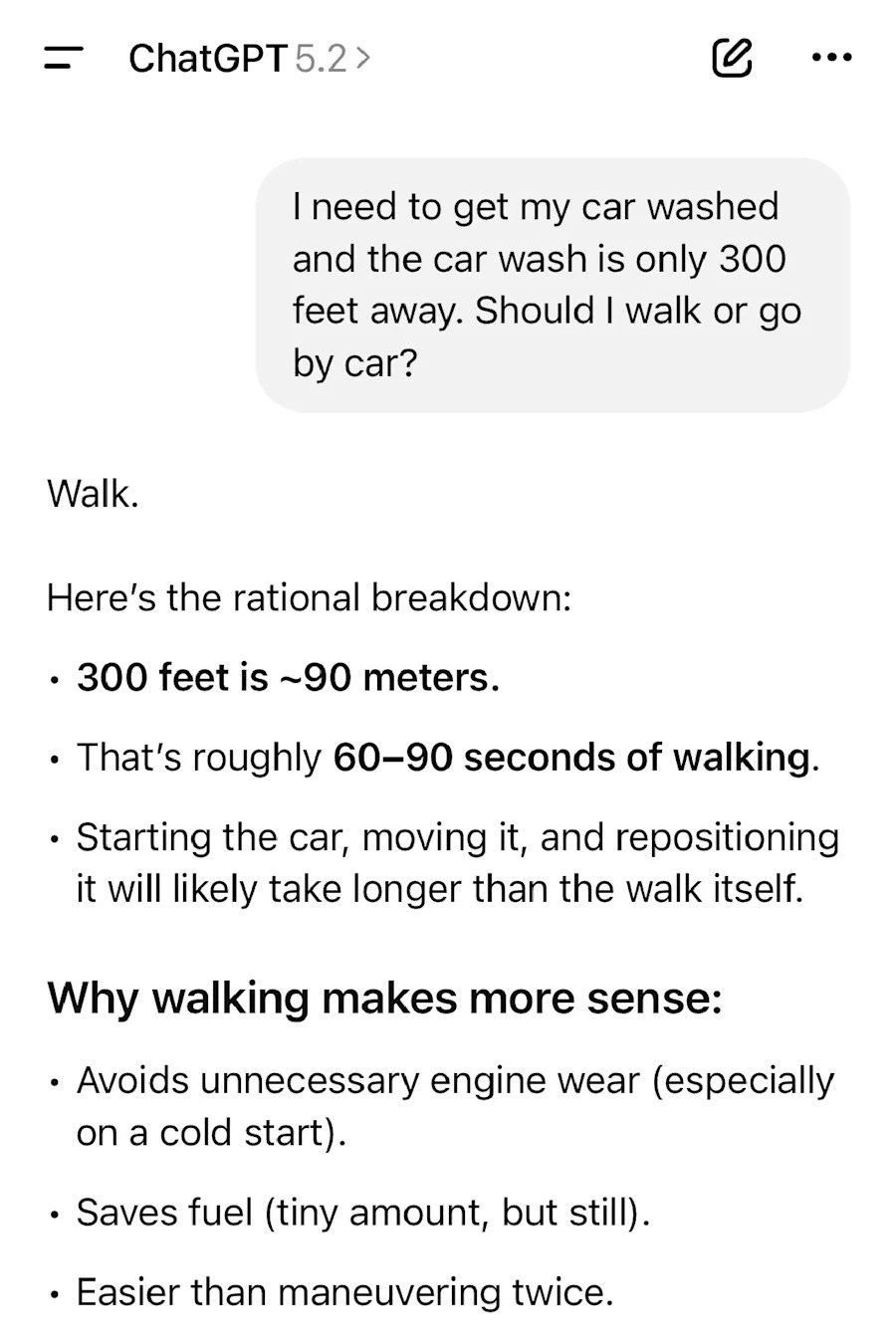
AI can be insanely good at coding and, on the same day, tell you to walk to a car wash that’s 40 minutes away. The frontier is jagged, not a smooth capability curve but a weird mix of genius and embarrassing failure.
The problem is that where AI is good and where it isn’t is not documented anywhere that matters. Not beyond evals and benchmarks that mean nothing to 99.9% of people. Which means that for someone to get value from AI, three things have to happen simultaneously: AI can actually do it, the user discovers that it can, and the user decides to try it.
The first one is the AI labs’ job. The second and third are ours.
The job of product builders
Let me make this concrete with an example not far from reality. Let’s say that today’s frontier AI can perform executive assistant (EA) tasks with a high degree of autonomy and accuracy. Especially after the recent wave of agent capabilities initiated by OpenClaw.
Great. We all get a free EA. What a wonderful world.
Except most of us have never had an EA. So we do what I’d do: ask it to reorganize my calendar. Maybe, once I build enough trust, book a flight. And I think I’m getting good value.
But a good EA is way more than that. A great EA is Donna from Harvey (if you don’t get the reference you are missing out on a great TV show). A good EA is not calendar hygiene, it goes deep into leverage: framing your decisions before you have to make them, filtering ruthlessly what actually deserves your attention, closing every loop so nothing falls through the cracks, and pressure-testing your ideas with someone who has no ego in the outcome (full disclosure: I haven't had a real EA, that's actually from a conversation with an AI about what one would do).
And AI can deliver roughly 70% of this today. Not 100%, deep intuition and strategic feel still need time and context. But 70% is a lot. Most people are getting 0%.
The gap between 0% and 70% is not a model problem. It’s an imagination problem. I can’t picture what a great EA does, so I can’t ask for it. I can’t picture what great AI product look like, so I can’t ask for it.
Responsibility #1: close the gap of imagination. Make sure people can picture what good looks like, so they can ask for it.
The second problem is different. Even when users know AI can do something, they still need to want to do it.
In most cases, what we’re offering is an improvement on the status quo. And most people don’t spend their days optimizing. That’s just a few sickos like me who can’t do anything twice without thinking about scripting it.
Fabriccio Bolsi, Prosus CEO, put it plainly at a recent meeting: “I’ve tested all your agents and none of them gets me what I want for dinner faster and more smoothly than the two taps on the iFood app.” Hopefully it wasn’t talking about Luzia, but in any case, that’s a slap and stinks because it is mostly true.
Christensen’s rule: if you want to change someone’s default, your experience needs to be 10x better. Not marginally better. Not “AI-powered” better. Actually just better, in a way people feel immediately. AI has created the room for that 10X experience, we need to deliver on it.
However, we keep shipping chatbots that look identical to each other, chasing flashy demos and one-shot Loom videos, when we should be obsessing over boring AI that just works for the 80% of people that don’t spend the day behind a screen. I wrote about this in my 2026 predictions, and the local AI angle specifically here.
Responsibility #2: stop building AI for demos. Build it for defaults.
Both of these things, imagining on behalf of users, and building for defaults instead of demos, matter for two reasons.
For consumer AI companies closing this gap is existential. It’s the difference between building something that sticks and building something people try once, and then never again.
But more importantly: if we don’t solve this, the gap between those who use AI at its full potential and those who don’t becomes too wide to close. That’s not a product problem. That’s a society problem.
It’s the reason I started Luzia.