
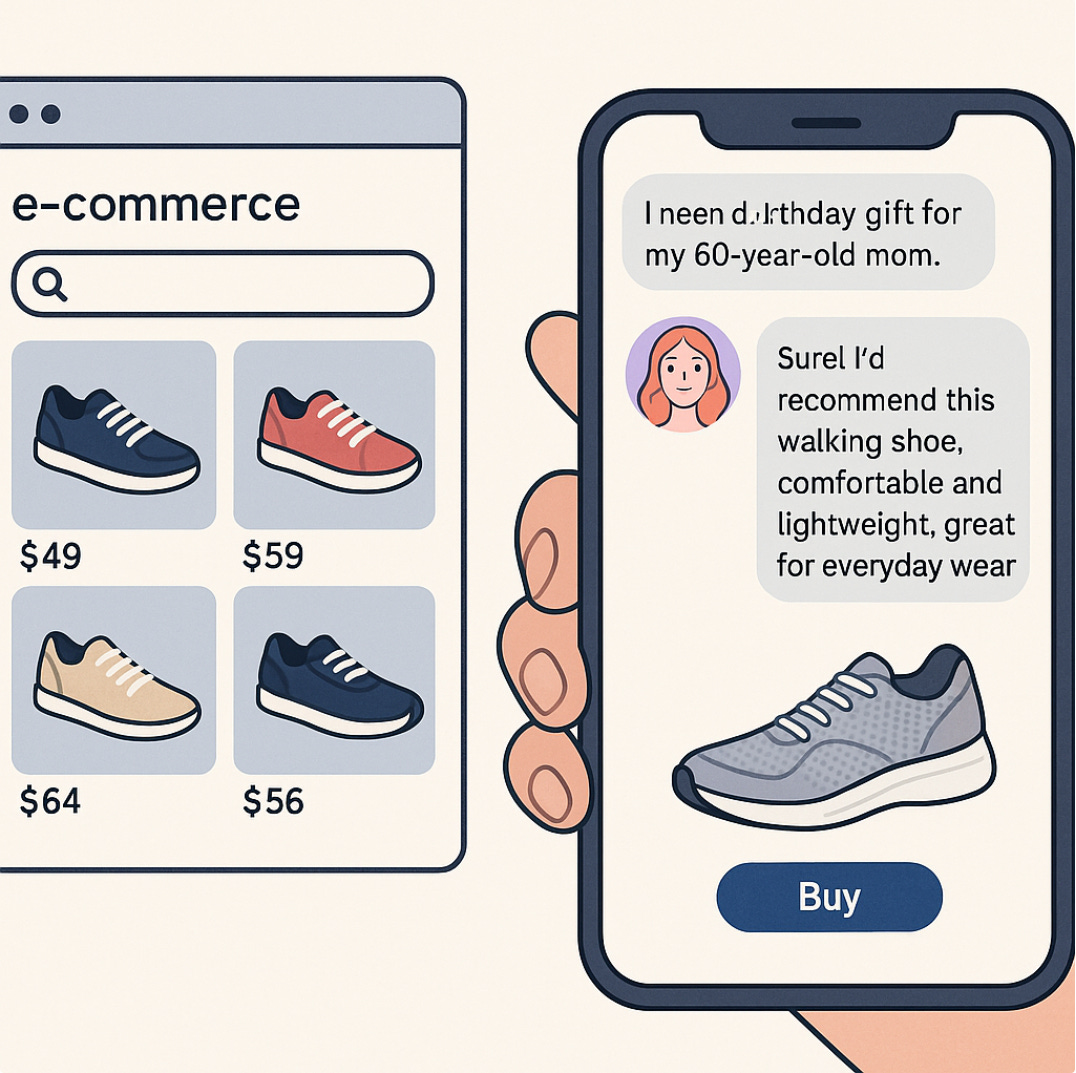
A single sentence-typed or voiced-into a chat window: “I need a birthday gift for my 60-year-old mom.” Luzia replies instantly with three perfectly‑priced suggestions, a short explainer of why each fits, and a button to buy right there. Because agents now have memory, Luzia remembers the last two gifts you bought her and your preferences on brands and stores.
No search pages, no comparison grids, no banner ads-just a conversation that smoothly transitions from intent to purchase via a trustworthy recommendation. At that moment, the traditional storefront disappears, replaced entirely by the prompt.
The core thesis of this article is straightforward: GenAI will fundamentally reshape e-commerce, whether merchants like it or not, because those who have the demand hold the power—but for merchants ready to adapt, significant opportunities await.
One topic I’m parking for a future post is how performance-marketing budgets will likely migrate from keywords and social feeds to paid placement—my thinking there isn’t fully baked yet, and it deserves its own deep dive.
It's All About Demand...
Power on the internet belongs to those who aggregate demand. Amazon capitalized on Prime and its one‑click checkout to capture purchase intent; Facebook and Instagram did the same for discovery through targeted ads. GenAI assistants eliminate the last remaining friction: the cognitive load of translating desire/problems into search keywords, and if properly executed, all the other parts of the funnel. As these interfaces internalize catalogs and simplify checkout processes, shopping becomes an interaction with a conversational agent. In this new reality, the conversational layer-not the merchant-owns the customer relationship.
Why are Amazon ‘brands’ called QDYZPP and GHKWXUE? Because inside the Buy Box, any random string will do—watch the breakdown.
For merchants, this presents challenging trade-offs. Historically, brands that chose direct‑to‑consumer strategies sacrificed marketplace visibility in exchange for full control over customer relationships, even as they became increasingly dependent on platforms like Facebook for customer acquisition. On the flip side, selling through someone else’s platform, i.e., Amazon, provided immediate distribution but eroded margins and data sovereignty. An agent-driven, GenAI aggregator further tightens these constraints: if customers never visit your site, does your carefully‑crafted brand experience still matter? I think the article that best captures this idea is Ben Thompson’s take on Nike returning to Amazon.
...And Demand Follows Great Experiences
The obvious follow-up is … but will customers adopt GenAI? Customers follow great experiences.
Customers will adopt GenAI shopping because the value proposition is obvious: clearly describing a "job-to-be-done" to an AI is faster and more intuitive than endless scrolling or search optimization. “I need a new pair of shoes to play tennis”. AI can combine reviews, specifications, social proof, and price data into clear, personalized recommendations. The agent’s memory further streamlines the shopping process by retaining user preferences, previous purchases, and shopping habits.

Making Lemonade
If life gives you lemons, make lemonade. Merchants must work on two dimensions. The first is the obvious: embrace AI and start exploring different channels and opportunities (Luzia, ahem, ahem). The second is to reorient their strategies around three familiar yet crucial dimensions: selection, brand, and leverage over fixed costs.
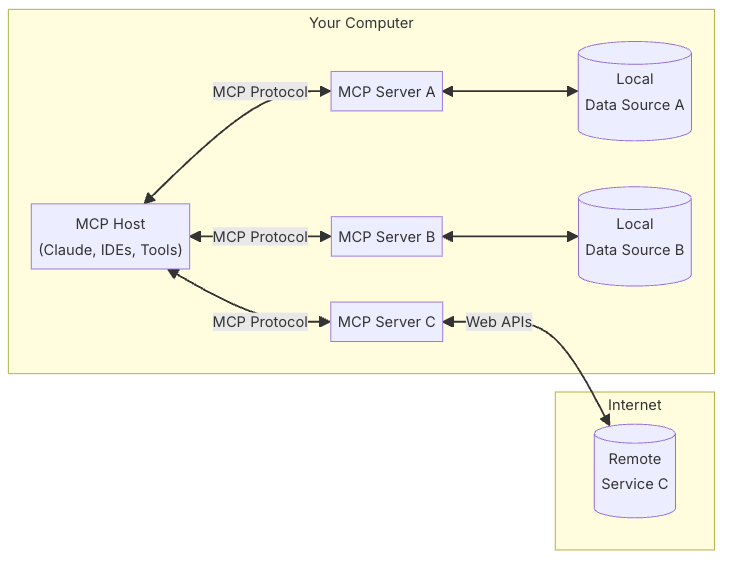
First, selection. AI assistants can only recommend products they can access and understand. Merchants should expose their catalog through modern commerce APIs (such as MCP standards), inventory endpoints, and rich metadata. But merely being eligible is not enough. Real competitive advantage will come from unique inventory -exclusive SKUs, limited‑run collaborations, or special bundles. The more differentiated the inventory, the greater the likelihood it surfaces as the AI’s recommendation, anything other than that will inevitably lead to commoditization (the TEMU effect)

Second, brand. Aggregators commoditize suppliers unless consumers specifically request them by name. Develop compelling narratives, build community around your brand, and maintain physical or unique digital experiences that keep your brand embedded in consumers’ memories. Brand recall ensures the customer requests ”Nike Pegasus 43,” rather than a generic substitute, “shoes to run my first 10k”.
Third, fixed‑cost leverage. Every conversational AI transaction will implicitly carry a toll, whether as revenue share, sponsored placements, or the opportunity cost of lost organic traffic. Merchants must build models where gross margins scale faster than these imposed costs. Adopting subscriptions, membership perks, and owned fulfillment capabilities convert customer‑acquisition costs into amortized assets. Amazon’s strength was always in making its warehouse network incrementally more efficient with each additional order-merchants must apply this principle at a micro-level.
What’s in it for us, agents?
This is an easy question. For agents of the world, such as Luzia, this is an opportunity to deepen the relationship with the user by unlocking new areas of value, making the vision of a full-blown assistant a reality. This ultimately has two main benefits:
As I explained in my post on AI monetization, the more value is unlocked, the more opportunities there are to capture it. With valuable transactions happening through our platform, opportunities for monetization arise in obvious forms-transaction fees, product placements, rebates, and many others that will need to be invented. Once an agent owns demand, it can levy a toll on every downstream supplier.
The second benefit is the data flywheel. The more engagement and use cases are unlocked, the better we get to know our users, the more local we can be, and thus the more we can help them.
Monetization and data matter only while users trust the agent’s incentives. Push paid placement past relevance and the flywheel stalls.
Aggregator Overreach: A Cautionary Tale
When Amazon treated every brand as a fungible line in a search-results table, Shopify and Facebook stepped in: merchants could buy demand, own the customer file, and keep their margin and information. The same cycle hit restaurants: high take-rates and zero data on Uber Eats or Rappi pushed many to multi-home (selling in more than one platform). Lesson learned: squeeze too hard and the supply you aggregate funds its own escape route. For GenAI agents the guardrail is clear—stay additive. Charge a toll for convenience, yes, but leave room for brands to differentiate and for merchants to build equity, or the next Shopify-plus-Meta combination will rise from the margins you compress.
The Hard Part: Technical Challenges That Require Thinking
Many Unsolved Challenges = Opportunities
If the goal is frictionless commerce triggered by a conversational prompt, today’s reality still presents several technical hurdles at each step of the funnel. Let’s unpack them, starting from the moment intent is expressed:
Discovery and Matching. Agents must interpret subtle cues and context. While modern LLMs excel at natural-language understanding, they still need structured, continuously updated data to return accurate matches. Merchants have to expose rich product metadata via modern commerce APIs-think MCP standards or product-JSON schemas—so agents can spot nuances, like distinguishing a “giftable” watch from one built purely for performance. Just as Shopify became the picks-and-shovels vendor for merchants squeezed by Amazon’s Buy Box, a new class of ‘MCP enablers’ will surface catalogs and inventory to GenAI agents—Shopify-for-APIs instead of Shopify-for-web pages. Scalability matters: manually re-indexing every merchant catalog is neither scalable nor cost-effective. As adoption of a common standard reaches critical mass, laggards will be sidelined-much like banning Google from indexing your site.
UI and UX. How you shop depends on what you are shopping, whether is a staple item or a one off purchase and when you are shopping it. Today’s familiar—if clunky—grids at least set expectations. Replacing them will require fast, messy iteration. Our “book-a-restaurant” beta proved it: a chat reply naming the venue fell flat; users also demanded photos, ratings, even table snapshots. The lesson is clear: GenAI must learn to assemble the right blend of text, cards, and visuals for each scenario, and that will take relentless A/B testing before the interface feels both novel and trustworthy.

Recommendation and Memory. Personalization depends on robust (and compliant) memory. Technology in this area is improving rapidly-our own memory layer has increased engagement by approximately 300 basis points-but memory comes with marginal costs beyond electricity. The more context you want to add, the more expensive each query becomes. Introducing memory without smart optimizations could quickly increase costs by 2-3X. Balancing performance, privacy, and unit economics will be an active area of experimentation.
Checkout and Payments. To deliver a true end-to-end, “job-to-be-done” experience, payments must be cracked-and this is where things get thorny. On one side: legitimate security concerns; on the other: fragmented regulation. Both are justifiable, yet both demand heavy innovation. Questions pile up:
Are users comfortable authorizing an agent to transact on their behalf-and under what limits?
Can the agent commit them to installments?
How do we sandbox hallucinations?
How do we navigate regulatory fragmentation?
And my personal favorite: How do we make any of this work within the iron grip of PSD2? (Forgive the sarcasm-my last two years at Amazon were spent ensuring PSD2 didn’t sink the subscription economy.) How do we make AI that uses Pix in Brazil? Local matters
The good news: these challenges are solvable. Forward-looking merchants who engage with emerging standards (MCP and MCP-UI) and shore up their technical foundations won’t just clear the hurdles-they’ll define the track for everyone else. Partnering early with regulators will be equally critical: help shape the rules or live by rules someone else shapes for you.
From Global Model to Local Moment
GenAI supplies infinite IQ, but only local texture—Pix in São Paulo, cash-on-delivery in Buenos Aires, contra-entrega riders in Bogotá—turns that intelligence into sales. Agents and merchants that ignore such rails are restaurants that forgot to cook. The flip side is favorable path-dependency: markets that skipped credit cards and desktop web have no habits to unlearn, letting super-apps in emerging economies sprint past incumbents still chained to legacy infrastructure.

That’s why local AI is the real moat. Merchants and assistants that bind global models to on-the-ground data—local SKUs, regional pricing, real-time FX through providers like iFood, Rappi, or small mom-and-pop stores—will spin a faster flywheel: more trust → more usage → richer context → better recommendations.
Where Does This End?
Ultimately, this transition will result in a handful of dominant AI assistants integrated deeply into operating systems, messaging apps, and smart devices. We’ll see fierce competition around schema standards, product feeds, and promotional formats. As the competitive landscape evolves, value will increasingly shift towards the point of intent, replicating the historic shift from shelf space in physical stores to search results online. Storefronts will persist, but increasingly as APIs rather than as consumer destinations.
This transformation, however, is not a threat but an opportunity. GenAI commerce represents an additional distribution layer rewarding uniqueness, memorability, and operational efficiency. The way I think about it is as Uber and the car-riding business, Uber TAM wasn’t limited to taking market share from taxis, which they did, but expanding the mobility to many more rides.
Merchants should approach this prompt-driven landscape strategically, just as they approached the browser two decades ago-with clarity about what only they can own. Agents might capture customer queries, but merchants will always own the differentiated answers that keep customers returning.
In short, the path from chat prompt to checkout isn’t a straight API call; it winds through regional regulations, vernacular, and trust. Merchants and agents that embed those local realities into their data flywheels will turn one-off transactions into durable, high-frequency relationships.

Great read
Hey Alvaro, great text. I love Luzia, and I'm excited about agentic commerce in the future. Here are some thoughts on the payment piece of agentic commerce for your consideration: https://www.youtube.com/watch?v=dupi-i9zy20. I'm Happy to chat about it in Madrid if you're up for it. Best, Damijan